



Mahler Listening GuideSymphony no. 1 in D Major
by Bettie Jo Basinger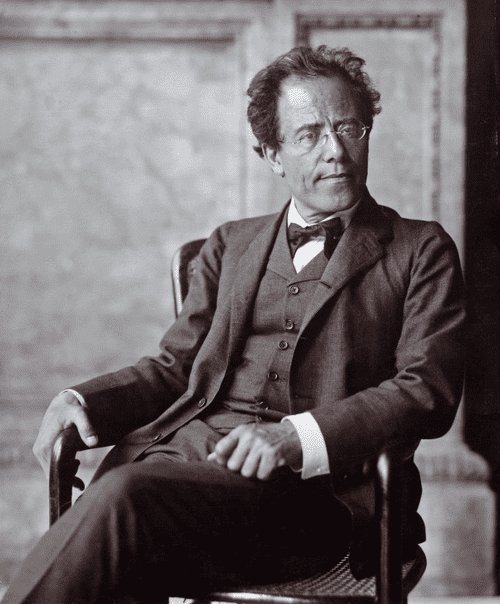
Gustav Mahler
Work History
Gustav Mahler finished his first symphony in March of 1888 while employed as the second conductor at the Stadttheater (City Theater) in Leipzig. Although he may have started work on the piece as early as 1884, evidence suggests that the bulk of composition took place within the six weeks immediately prior to the symphony’s completion. A mere two months later, the composer departed from the Stadttheater to become the Artistic Director of the Royal Hungarian Opera, and the piece therefore received its first performance in Budapest on 20 November 1889 with Mahler himself conducting.
At this premiere, the composer designated the work not as a symphony, but as a “symphonic poem in two sections.” The opening section consisted of three movements: the present-day first movement, an Andante that Mahler eventually withdrew from the piece, and the music we now know as the second movement. Following this, the final section of the so-called “symphonic poem” presented what would become the third and fourth movements of the four-movement Symphony No. 1.
Perhaps because the Budapest performance proved unsuccessful, Mahler revised the symphony between 1893 and 1896. Since no copy of the original version survives, the full extent of the changes remains unknown; however, a letter Mahler wrote to Richard Strauss on 15 May 1894 intimates drastic modification to the instrumentation. Further alterations include the addition of a program, and the composer circulated his new “explanation” for the piece on 27 October 1893 in Hamburg, where Mahler was then serving as the chief conductor at the Stadttheater. Now collectively dubbed “Titan, a tone poem in symphonic form,” each of the five movements received a title, and three of them also took on brief verbal descriptions. Mahler retained these titles and summaries, with only minor modifications, for a Weimar performance conducted by Strauss on 3 June 1894.
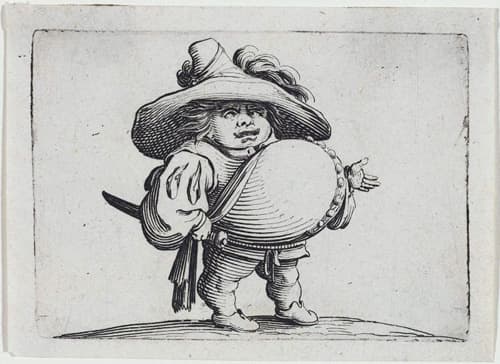
Commonly translated as Grotesque Dwarves, Various Hunchbacked Figures offers a more literal translations of Jacques Callot’s Varie figure gobbi, a collection twenty etchings of dwarves. Callot titled this image “L’homme au gros ventre orné d’une rangee de boutons” (“Man with a Great Belly, Ornamented with a Range of Buttons”).
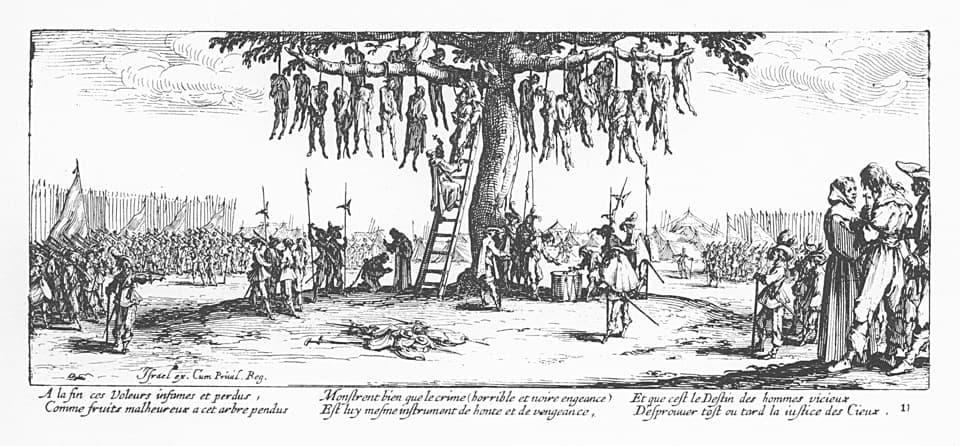
Callot’s 1633 series of etchings entitled from the series Les misères et les malheurs de la guerre (The Miseries and Misfortunes of War) captures the atrocities of war, especially violence against civilians. Although the images depict no particular battle, occupation of Lorraine—where Callot resided—during the Thirty Years’ War likely influenced the series. The publisher issued “La pendaison” (“The Hanging”) as the eleventh of eighteen etchings in the set.
Listening Guide for the First Movement
The opening movement of Mahler’s First Symphony begins with an introduction marked “Slow. Dragging. Like a sound of nature” (“Langsam. Schleppend. Wie ein Naturlaut”). Here Mahler presents the materials that will generate the rest of movement—as well as many of the melodies that will appear in the remainder of the symphony—over hushed, sustained A’s. These germinal ideas consist of a series of descending fourths; an ascending fanfare stated first by the clarinets in their low register and later repeated by offstage trumpets; and the call of a cuckoo that audibly relates to the descending fourths. These materials initially cede to a lyrical melody in the French horns, and then to a chromatic bass line as the main body of the movement approaches. When the tempo speeds up, the sonata form traditionally used in symphonic first movements commences. However, Mahler modifies this formal scheme by omitting the contrasting theme. Instead, he presents only one melody, a tune seemingly derived from both the cuckoo call and the descending fourths of the introduction. Nevertheless, this melody existed prior to its use in this symphony. Mahler initially composed it as a song setting for his own poem “Ging heut’ morgen übers Feld” (“I went over the field this morning”) which he included as the second song of Lieder eines fahrenden Gesellen.Ging heut’ morgen übers Feld
Tau noch auf den Gräsern hing
Sprach zu mir der lust’ge Fink
“Ei du! Gelt? Guten Morgen! Ei gelt?
Du! Wird’s nicht eine schöne Welt?
Zink! Zink! Schön und flink!
Wie mir doch die Welt gefällt!”
Auch die Glockenblum’ am Feld
Hat mir lustig, guter Ding’,
Mit den Glöckchen, klinge, kling
Ihren Morgengruß geschellt:
“Wird’s nicht eine schöne Welt?
Kling, kling! Schönes
Wie mir doch die Welt gefällt! Heia!”
Und da fing im Sonnenschein
Gleich die Welt zu funkeln
Alles, Ton und Farbe gewann
Im Sonnenschein!
Blum’ und Vogel, groß und klein!
“Guten Tag! Ist’s nicht eine schöne Welt?
Ei du! Gelt? Schöne Welt?”
Nun fängt auch mein Glück wohl an?
Nein! nein! Das ich mein’
Mir nimmer blühen kann!
I went over the field this morning
Dew still hung on the grasses
The merry finch spoke to me
“Hey you? Right? Good morning! Hey, isn’t it?
You! Isn’t it a beautiful world?
Chirp! Chirp! Nice and sharp!
How the world pleases me!”
Even the bluebells in the field
In cheerful spirits, merrily rung
With little bells, ding, dong
Their morning greeting:
Isn’t a beautiful world?
Ding! Ding, dong! Beautiful thing!
How the world pleases me! Hooray”
And there in the sunshine
The world immediately began to sparkle
Everything gained sound and color
In the sunshine!
Flower and bird, big and small!
“Good day! Isn’t it a beautiful world?
Hey, you! Isn’t it? A beautiful world?”
Now will my happiness also begin?
No! No! The happiness I mean
Can never bloom for me!
Listening Guide for the Second Movement
Although Mahler labeled the second movement as a scherzo in early incarnations of his First Symphony—and for this reason, many commentators continue to refer to the movement as such—his final revision carries only the heading “Kräftig bewegt” (“Strongly moving”). Nevertheless, even without the word “scherzo” appearing on the score, the composer retains the A B A structure (i.e., dance 1, dance 2, dance 1) that has shaped dance movements of symphonies since the eighteenth century. In this case, however, Mahler chose to use the ländler as his dance type. The A section begins with the celli and basses sounding a figure that derives from the descending fourths heard in the first movement, above which the violins “whoop” a few times before beginning the main ländler tune. This melody again resembles the opening movement, especially through its stepwise ascent and closing gesture that recalls the previously-heard cuckoo calls; small turn figures even suggest fragments of “Ging heut’ morgen.” After repetition, variation, and an additional heightened restatement of these ideas, this first portion of the second movement comes ringing to its conclusion. The contrasting dances presented in the B sections of both symphonic minuets and scherzos generally receive the designation “trio” (due to the tradition of employing reduced orchestration—¬originally two oboes and bassoon), and this portion of Mahler’s movement constitutes no exception to the rule. Here a solo horn announces a slower tempo, as well as a gentler, more lyrical character. The composer thus moves into more waltz-like music that at times evokes the dance movement of Tchaikovsky’s Fifth Symphony in E minor (1888)—yet likely by coincidence, since Tchaikovsky did not finish work on this piece until a few months after Mahler completed the initial version of his First Symphony— before the ländler returns to round off the movement.Listening Guide for the Third Movement
Marked only as “Feierlich und gemessen, ohne zu schleppen” (“Solemn and measured, without dragging”), the third movement of the symphony nevertheless clearly presents the listener with a funeral march. Yet as the audience starts to perceive that the composer is quoting the children’s song Bruder Martin, it also becomes evident that this music does not represent a typical example of this kind of piece. In order to make his melody more suitable for the suggestion of a funeral procession, the composer has recast it in the minor mode and placed its first statements in a round for unconventional instruments: solo bass, solo bassoon, and solo tuba. More and more instruments join the round as the timpani obsessively sound a brooding march rhythm—which relates to the first movement’s descending fourths. Other players, like the oboe and shrill E-flat clarinet, add a countermelody to the mix. The music builds to a peak above the rumblings of a tam-tam, and then the march subsides to usher in the next portion of the movement. As mentioned above, Mahler’s discarded program linked this movement both to Callot and a fairytale in which forest animals lead a funeral procession in honor of a fallen hunter. While scholars now believe that Moritz von Schwind’s drawing of this folk scene instead served as the composer’s inspiration, the scenario of the huntsman’s funeral provides a reasonable explanation for Mahler’s curious (if macabre) decision to base a funeral march on a children’s melody. However, little beyond the irony of the animals’ false sorrow suggests the dances—which evoke the Jewish genre of klezmer—that follow the funeral march in the score. The music now alternates between two hyperbolized dances, the second of which Mahler asks the performers to play “mit Parodie” (“with parody”). Again regaling the listener with unique orchestration—a pairing of oboe and trumpet duets proclaims the first dance, while clarinets accompanied by the klezmer standard of bass drum and cymbal deliver the second—each appears two times before echoes of the funeral march whisk away this section’s exuberance.
Moritz von Schwind’s drawing Wie die Tiere den Jäger begraben (As the Animals Buried the Hunter) of 1850, here rendered as a woodcut, possibly inspired the third movement of Mahler’s Symphony No. 1.
Die zwei blauen Augen von meinem Schatz,
Die haben mich in die weite Welt geschickt.
Da mußt ich Abschied nehmen vom allerliebsten Platz!
O Augen blau, warum habt ihr mich angeblickt?
Nun hab’ ich ewig Leid und Grämen!
Ich bin ausgegangen in stiller Nacht,
Wohl über die dunkle Heide.
Hat mir niemand Ade gesagt.
Ade! Mein Gesell’ war Lieb’ und Leide!
Auf der Straße steht ein Lindenbaum,
Da hab’ ich zum ersten Mal im Schlaf geruht!
Unter dem Lindenbaum,
Der hat seine Blüten über mich geschneit,
Da wußt’ ich nicht, wie das Leben tut,
War alles, alles wieder gut! Everything,
Alles! Alles! Lieb und Leid! Everything!
Und Welt und Traum!
The two blue eyes of my sweetheart
They have sent me into the wide world.
I must say goodbye to this well-loved place!
O blue eyes, why did you look at me?
Now I have eternal sorrow and grief!
I went out into the quiet night,
Well across the dark heath.
No one said goodbye to me.
Goodbye! My companions are love and sorrow.
A linden tree stands on the road,
There I found rest in sleep for the first time!
Under the linden tree,
That snowed its blossoms over me,
I knew not, how life went on,
everything was good again!
Everything! Love and sorrow!
And world and dream!