
Héctor Armienta’s ZorroThe Double World of Don Diego de la Vega
by Dr. Carol Anderson
Thanks to the dozens of versions of Zorro that exist across media, it can be tricky to nail down a consistent biography, but some basic facts run through every iteration of the rapier-wielding vigilante. Don Diego de la Vega was born in Alta California, a Criollo, to use terminology of the original settlers, and was the only son of widowed Don Alejandro de la Vega, the wealthiest hacendoro, or landowner, in El pueblo de los Ángeles. Don Diego was sent to university in Spain where he learned swordplay but is summoned home to California when a cruel dictator assumes the leadership of the town. In some versions, Don Diego returns to find his father deceased; in others he lives with his father in the large hacienda. Growing up as a child of privilege, Don Diego begins as a foppish, ineffectual coward drifting through life without conviction or purpose.
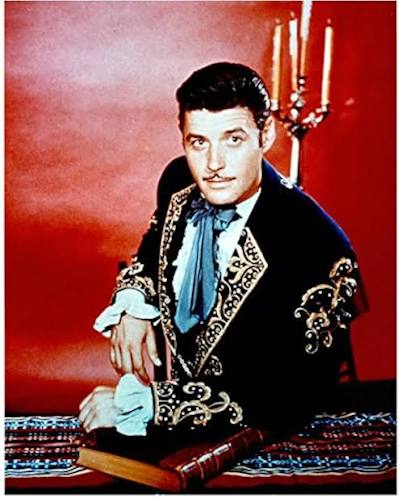
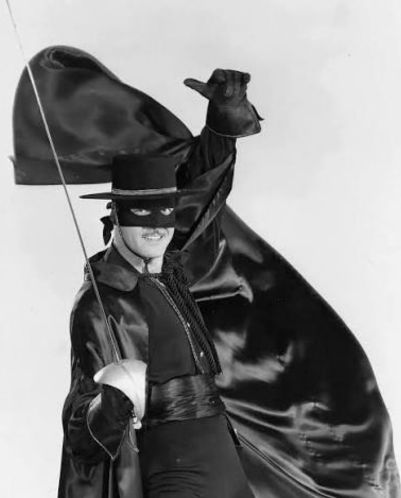
But as his awareness of injustice and cruelty to the poor and downtrodden grows, he adopts the dual persona of Zorro. Zorro, the “fox,” supports the rights of the indigenous peoples and commoners of the region, and crusades against the cruelty of corrupt government officials and other evil doers.
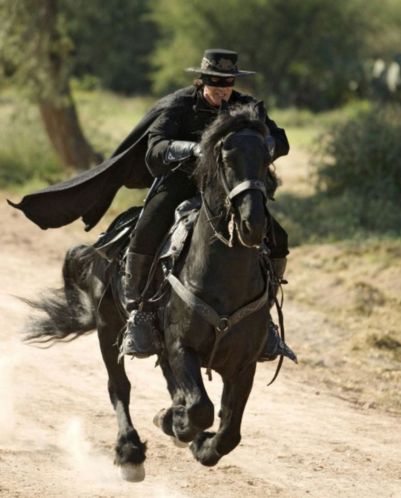
Zorro hides his identity with a mask, often a domino or bandit-style, and wears all black clothing, usually accessorized with a dramatically flowing cape.
In the 1919 pulp novel The Curse of Capistrano, his first appearance, he describes his dual life thus: “It is a peculiar thing to explain, señores. The moment I donned cloak and mask, the Don Diego part of me fell away. My body straightened, new blood seemed to course through my veins, my voice grew strong and firm, fire came to me! And the moment I removed cloak and mask I was the languid Don Diego again. Is it not a peculiar thing?” Don Diego/Zorro maintains a secret “lair” within the network of cellars and tunnels underneath the hacienda. His majestic black horse, first called Tornado in the 1950s Disney television show, is stabled in these cellars as well.
Not only is Zorro the most skilled horseman and fencer in Alta California, but he is also well-versed in methods of infiltration, espionage, and deceit. He delights in making fools of the cruel nobility of Los Ángeles and ironically creates his own love triangle by loving a young local woman who only has eyes for Zorro. Showmanship is also a key component of his justice. In almost every situation where Zorro defends an underdog, the noble vigilante leaves his calling card-using his rapier to slash the letter “Z” into whatever structure is at hand.
Different eras may have changed Zorro’s clothes, enemies, love interests, and even his politics, but the basic character remains remarkably consistent: a man who turns disguise, theatricality, and privilege into weapons against injustice.