
BEETHOVEN: Symphony No. 9, “Choral”
By Noel Morris
It’s hard to overstate the impact of Beethoven’s nine symphonies. Generations of composers idolized him. After other 19th-century symphonists failed to produce a tenth symphony, including Schubert, Bruckner, Dvořák, and Mahler, people called it “the curse of the ninth” — no one could exceed Beethoven.
Some might say Beethoven treated his chorus like a piano, showing little regard for the prolonged, punishing high notes that he requires of the singers.
In keeping with Beethoven’s message of universal brotherhood, the European Union adopted his “Ode to Joy” as its anthem.
What to Listen for
In the first two movements, Beethoven whips up a maelstrom, while allowing glimmers of light to shine through, modeling the human spirit as it faces life’s struggles.
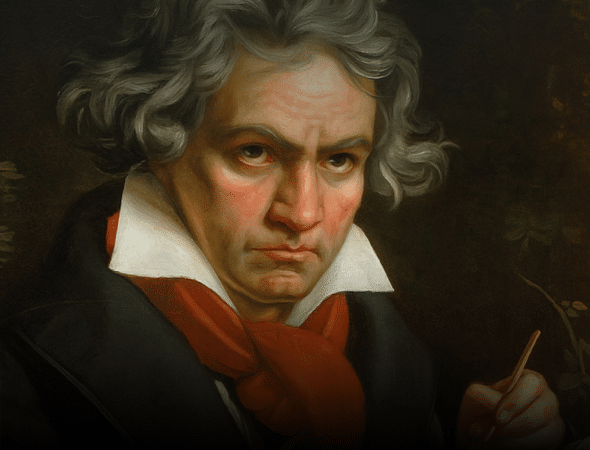
Ludwig van Beethoven
born December 1770, in Bonn
died March 26, 1827, in Vienna
Symphony No. 9 in D minor
composed 1823-1824
premiered in Vienna, in 1824
last performed by the Utah Symphony in November 2023 with conductor David Robertson
The Backstory
Many concepts come to mind with Beethoven’s Ninth Symphony—epic, choral, monumental, revolutionary—and the movie Die Hard. The 19th-century German philosopher Friedrich Nietzsche suggested this:
“At a certain place in Beethoven’s Ninth Symphony, …[one] might feel that he is floating above the earth in a starry dome, with the dream of immortality in his heart; all the stars seem to glimmer around him, and the earth seems to sink ever deeper downwards.”
The Ninth Symphony does feel otherworldly. It occupies a space beyond our everyday experience. Indeed, it was written by a deaf man. Through more than an hour’s worth of music, Beethoven had no auditory point of reference. It all billowed from a singular imagination. And so the Ninth Symphony stands alone, and at times signifies times of great importance. Leonard Bernstein, for example, conducted the Ninth to mark the fall of the Berlin Wall in 1989.
Often, in this context, we skip to the end of the Beethoven story: a deaf composer wrote a series of masterpieces. We spend less time thinking about a man—a musician—coping with an especially cruel disability and a crushing sense of loss.
Beethoven had moved to Vienna in 1792, ostensibly to study composition with Franz Josef Haydn. Although the two didn’t click, the Viennese nobility latched onto the younger composer. With Europe’s “who’s who” looking on, he wowed people with his piano improvisations—the wellspring of his ideas. After a brutal childhood, Beethoven finally felt like he mattered.
For all the astonishing architecture associated with his music—massive works that grow from tiny bits of material—composition was a scattered enterprise. Beethoven’s sketchbooks contain ideas for many different works, side-by-side, that would sometimes take years to germinate. In this way, he cranked out reams of music, often centering around his piano playing. He presented his first four piano concertos featuring himself as soloist. By the time he presented the Fifth in 1811, his disability prevented him from performing. After completing his Eighth Symphony in 1812, he hit a dry spell.
Over the next few years, Beethoven acquired various ear trumpets while pressuring instrument builders to design a louder piano. He even devised a contraption to amplify the instrument, but his connection to the piano—the instrument that had been an extension of his soul—gradually slipped away.
Probably, Beethoven had always been a difficult person, but hearing loss magnified his personality quirks. He had a hot temper. Nevertheless, he had close friends and frequented restaurants with them, exchanging laughs and musings jotted on pieces of paper. From his conversation books, we know a lot about his daily life. He chronically suffered from gastrointestinal problems and various infections. For years, he fought to gain custody of his nephew, Carl. Medical bills, various therapies, and Carl’s tuition all led to financial distress. In response, Beethoven wrote what he called “trifles” to make money. Twelve years separate the Eighth and Ninth Symphonies.
The Music
A son of the Enlightenment, he held fast to Enlightenment principles, celebrating what he believed to be a God-given capacity for reason, science, progress, liberty, and equality. These values, he thought, were the key to happiness, not just for himself but for all humanity. Enter Friedrich Schiller.
Schiller published a poem in 1786 called “An die Freude” (“Ode to Joy”), which spread like wildfire among those who had a taste for revolution. According to Beethoven-biographer Jan Swafford, “The poem’s essence was the Enlightenment cult of happiness as the goal of life, the conviction that the triumph of freedom and joy will bring humanity to an epoch of peace and universal brotherhood, the utopia he called Elysium.” The poem models the style of the geselliges Lied, a song sung with beer steins hoisted in the air.
Three years after the poem’s publication, French workers stormed the Bastille, and Schiller distanced himself from his poem. Beethoven, on the other hand, never forgot it.
Beethoven regained his footing around 1819. Slowly, the gears began to turn, and he produced his Diabelli Variations and Solemn Mass. He completed the first movement of his Ninth Symphony in early 1823 and finished the piece in 1824. Paralleling the composer’s march from stone-cold silence to a mind-boggling inner world, the Ninth Symphony plots a heroic journey. It begins with a volcanic fury in D minor, a hulking tempest that spills into two movements. Nevertheless, little rays of sunshine pierce the clouds. Sliding into D Major, Beethoven foreshadows the symphony’s radiant conclusion, as if to say, “don’t give up the fight.”
Of the miraculous Adagio, Richard Wagner wrote, “How differently do these tones touch our hearts! With what blissful balm do they disarm our defiance, and assuage the frenzy of the soul’s despairing anguish, dissolving them into feelings of muted melancholy!” And with his finale, Beethoven finally realized his dream for the Schiller poem. At the same time, he introduced the concept of a symphony chorus.
Beethoven conducted the premiere of the Ninth Symphony on May 7, 1894 (sort of). In truth, he followed the score and indicated tempos to conductor Michael Umlauf, who had instructed the performers not to look at the composer.
Beethoven “flailed about with his hands and feet as though he wanted to play all the instruments and sing all the chorus parts,” recalled one witness. When it was over, contralto Caroline Unger reportedly approached the composer and turned him to face the cheering crowd.