The Barber of Seville online course by Dr. Paul DorganPart 1: The Musical Story of Act 1 Scene 1
by Dr. Paul DorganThe title of the opera
Gioacchino Rossini’s Almaviva, o sia L’inutile precauzione had its first performance in Rome’s Teatro Argentina on February 20, 1816. The title was a mix of Pierre Beaumarchais’s subtitle to his play Le barbier de Séville – “The Useless Precaution” – and the name of the hero, Count Almaviva. An earlier operatic adaptation of the play by Giovanni Paisiello (1740 – 1816) for Russia’s St. Petersburg Opera in 1782 had proved so popular throughout Europe that it was thought better not to use the play’s original title for Rossini’s new opera, though he referred to it in letters as Barbiere. Paisiello fans filled the Argentina that night and the new opera was judged a failure. Not so the second performance, which led to Rossini’s operatic version surpassing in popularity not only Paisiello’s opera but those by four other composers whose names have been lost in the mists of history: Nicolas Isouardi (1773 – 1818); Francesco Morlacchi (1784 – 1841); Samuel Arnold (1740-1802), a British composer; and Alexander Reinagle (1756 – 1809) who produced in Philadelphia in 1794 The Spanish Barber, or The Fruitless Precaution. Footnote (if we had them!): he was British-born to a Hungarian musician-father; emigrated to NYC in 1786, but soon moved to Philadelphia, then the Capital of the newly-independent country; his music was much admired by George Washington.About the overture
Almaviva began, as did most of Rossini’s operas, with an orchestral Sinfonia, which we would call an “Overture.” So, logically, our Musical Story should begin there. Which it does. Except that it can’t! The autograph manuscript score has no Sinfonia/Overture. Scholars claim that what the Roman audience heard on that disastrous opening night was an orchestral piece based “on Spanish themes”: apparently his Almaviva, the Spanish tenor Manuel Garcia, was not enamored of the aria Rossini had written for the hero to sing, at Figaro’s suggestion, to Rosina, and decided he’d substitute various Spanish songs to his own guitar accompaniment. Smart Rossini may well have orchestrated them to introduce them to the audience, so they wouldn’t sound totally out-of-place in the opera. Thankfully, whatever that potpourri was has been lost. The Sinfonia/Overture we now associate with Il barbiere was first heard at the La Scala premiere of Aureliano in Palmira in 1813; two years later he added 3 trombones to the score for the Sinfonia/Overture to Elisabetta, regina d’Inghelterra. It’s unclear when this already re-used piece was first attached to Barbiere. Also unclear is when the premiere’s titular Almaviva was replaced by Il barbiere di Siviglia, though we do know that six months after its Roman premiere, it was given in Bologna with the title by which we know it today; maybe then the re-cycled Sinfonia was attached to the newly titled opera? I guess we’ll never know for sure. Confused? Me too! But read on for more confusions! According to the Critical Edition (the one based on a thorough examination of the manuscript score; various other contemporary scores; and subsequent published scores): “Rossini’s manuscript contains many approximations, contradictions and quite a few errors.” Which is, perhaps, not surprising, given that the opera was composed in about three weeks! My score has this instrumentation: 2 Flutes (doubling 2 Piccolos); 2 Oboes; 2 Clarinets; 2 Bassoons; 2 Horns; 2 Trumpets; 3 Trombones; Timpani ; Gran Cassa (a bass drum); Sistro (bell – though the Google illustration bears no resemblance to what we actually hear, which is a triangle); Piano; Guitar; Strings. It seems the 2nd oboe; 3rd trombone; and timpani which play in the Sinfonia were carry-overs from Elisabetta, for they are not required anywhere else in the Barbiere score; the piano is to be used only in the “Lesson Scene” in Act 2: though the Critical Edition says “…we may presume that the piano was the instrument currently used in the theatre at the time, and that it was used also to accompany the recitative.” It’s worth remembering that the piano in 1816 was a completely different animal from today’s instrument: its sound was gentler than we’re used to today – a gentle cat’s purr to today’s lion roar. In his essay, The Composer at Work, in “Opera Guides #36”, prepared for English National Opera and Covent Garden productions of Rossini’s opera, John Roselli notes that many of Rossini’s predecessors were far more prolific than he and points out that “each of their works was commissioned for a particular group of singers in a particular theatre at a particular season, and could afterwards be dismantled and the best numbers recycled elsewhere – a practice which Rossini time and again resorted to in his own operatic career.” We might consider this shocking and/or cheating, but think about it: an opera proves a fiasco in Naples; so, since it’s not likely to be produced anywhere else, why not re-use the better bits of that score for an opera for Milan or Venice: audiences there wouldn’t have heard any of the music from the Neapolitan fiasco. This, let’s call it “ease of transport”, was possible because the rules governing the structure of the verses of a 19th-century Italian libretto were based on the number of syllables-per-line, rather than the number of stresses-per-line of English poetry: the slow section of an aria had to have, let’s say, ten syllables in each line, while the faster section had eight. Easy, then, to re-use music written for similar situations in two, or even three, different librettos. “Waste not, want not!” Right? But before you get on your high horse and gallop off to condemn these self-borrowings, consider the following (which would be a Footnote, if we had such a thing!) Handel was as guilty as Rossini of the same crime, if crime it be. For the last movement of his Eroica Symphony, Op. 55, Beethoven used the theme of his Op. 35 set of piano variations, composed a year before the symphony; and the choral section of his 9th Symphony, Op. 125, bears a striking resemblance to the choral section of his Choral Fantasy, Op. 80. Gustav Mahler was an inveterate self-borrower, re-using the melodies (in one instance the text as well) of earlier songs in various of his symphonies. But the most-wanted criminal in this regard should be the much-revered Johann Sebastian Bach. Self-borrowing is a petty crime compared to the 15 keyboard concertos in which he “borrowed” the solo line of a Violin Concerto by Vivaldi (six of those!); or one by Telemann; or an Oboe Concerto by Marcello; or works by various noble nonentities; and rearranged them for keyboard, giving scant credit to the original composers. Were the German audiences who first heard these keyboard concerti by Bach aware of his thievery? Of course not. No more was the Bologna audience aware that the Sinfonia/Overture they were hearing as the introduction to Il barbiere di Siviglia had been used twice before. This Sinfonia/Overture was but the beginning of Rossini’s many borrowings in Barbiere, and I’ll point out the ones I’ve been able to track down.Cast of Characters
Count Almaviva: Tenor Figaro, a barber: Baritone Rosina, ward of Dr. Bartolo: Mezzo Soprano Dr. Bartolo, a physician: Basso buffo Don Basilio, a music teacher: Bass Fiorello, Count Almaviva’s servant: Baritone Berta, Dr. Bartolo’s maid: Soprano Ambrogio, Dr. Bartolo’s servant: Bass Officer: Bass Street Musicians: Tenors; Basses Soldiers: Tenors; Basses
There is no female chorus, which may seem unusual, but really isn’t. (The dates after the operas’ titles are the years when Utah Opera produced them!) Neither Rossini’s La Cenerentola (1992; 2008), nor his L’Italiana in Algeria (1994; 2010) use a women’s chorus; there isn’t one in Verdi’s Rigoletto (1982; 1990; 2001; 2012). Obviously there were no female miners during the California Gold Rush, so Puccini’s La fanciulla del West (1982; 2004) has only a male chorus; ditto for Carlisle Floyd’s Of Mice and Men (1999; 2012), and Jake Heggie’s Moby Dick (2018). Many of you may remember Utah Opera’s productions of Benjamin Britten’s one-act “Church Parables” as part of the Cathedral of the Madeleine’s Festivals: Curlew River (1993); The Burning Fiery Furnace (1995); and The Prodigal Son (1996); which call for male voices only. But back to Il barbiere!The Musical Story of Part 1: Act 1, Scene 1
We are outside Don Bartolo’s house in Seville which has a balcony on the second floor. Count Almaviva’s servant Fiorello has hired a group of musicians who are determined to be as quiet as possible: “Piano, Pianissimo, without making any noise.” It’s doubtful that any of the Roman audience would have recognized that the music they were hearing is exactly the same as what the guys sang at the start of Act 2 of Rossini’s Sigismondo, which was not a great success at its Venice premiere in 1814.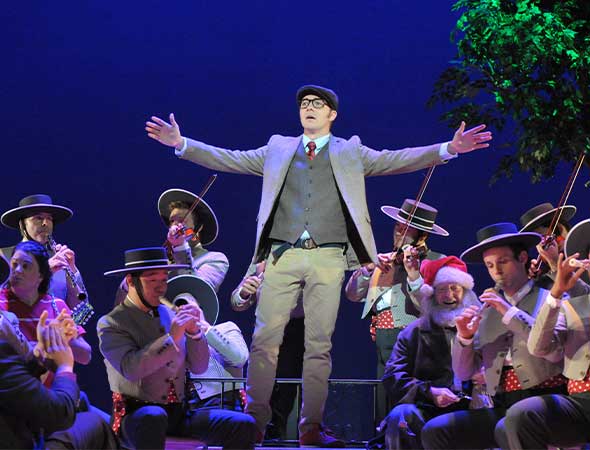
Opera Philadelphia’s production of The Barber of Seville. Taylor Stayton is Count Almaviva, who arrives in Seville in pursuit of the beautiful Rosina. Photos by Kelly & Massa.
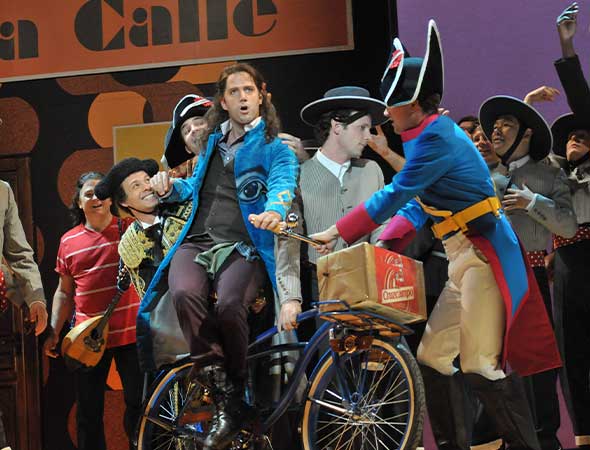
Opera Philadelphia’s production of The Barber of Seville. Figaro (Jonathan Beyer) makes his entrance with the famous aria “Largo al factotum”. Photos by Kelly & Massa.
Figaro explains more in his recitative after his Cavatina. Life is good: busy, but lots of fun, and he’s well-paid. Without his help no girl in Seville could marry: even widows need his help in finding second husbands. It turns out that Almaviva and Figaro know each other, though we never learn how they first met (a previous assignation arranged by Figaro perhaps?). The Count does not want his identity known in Seville. He fell in love with a beautiful girl he saw on the Prado, the daughter of an old doctor, and he now spends his nights under her balcony. As the barber, wigmaker, surgeon (not to mention his other services) to Don Bartolo, he’s familiar with the household: the girl is the ward, not the daughter, of the doctor; and that he… But before he can continue, the balcony door opens and the pair hide. Rosina wonders where “he” is and, of course, “he” reveals himself, much to her embarrassment; before she can deliver her letter to him, Bartolo joins her on the balcony and wonders about the paper in her hand: the words, she replies, of L’inutile precauzione – a new opera. An inside joke, since that was the subtitle of the opera at its Roman premiere! Bartolo laments that the new opera will probably be just a long boring piece of nonsense, but such is the lack of taste these days! This chunk of recitative is usually cut in performance, but it does set up Bartolo’s objection in Act 2 to the aria Rosina sings in the “Lesson” scene. “Oops,” says Rosina, “I’ve dropped it; please pick it up.” Alamviva salvages the note, so it’s no wonder Bartolo can’t find it: perhaps, suggests Rosina, the wind has blown it away. But the searching only annoys Bartolo the more and he orders her inside and determines to brick up the balcony as he re-enters his home.