
The Little Prince Online Course by Dr. Carol AndersonPART 3 – The Life of Antoine de Saint Exupéry, author of the novella The Little Prince
by Dr. Carol Anderson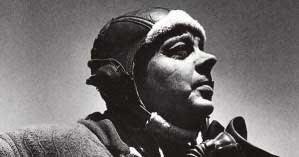
Antoine de Saint-Exupéry
Adventurer, pilot, poet, and writer, Antoine de Saint-Exupéry (1900-1944) was born into an aristocratic Catholic family in Strasbourg, France. The untimely death of his father, when young Antoine was only four years old, plunged the family into impoverished nobility. Saint-Exupéry had two sisters and one golden-haired brother François. Brother François’ death at age 15, with Antoine at his bedside, provided one inspiration for the “death” of the Little Prince.
Saint-Exupéry’s writing career began to “take off” after the publication of his novella L’Aviateur (The Aviator) and his novel Courrier Sud (Southern Mail) published in 1929. His fame and influence was fully established with the 1931 release of Vol de nuit (Night Flight), a semi-autobiographical novel based on his experiences as a mail pilot based in Buenos Aires, Argentina. That same year he married Consuelo Suncin, who proved to be both his torment and his muse. She wrote a memoir after Antoine’s death in which she asserts that she was the inspiration for the character of the Rose in Le petit prince.
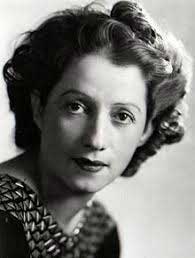
Consuelo Suncin
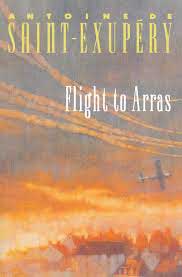
Flight to Arras
Saint-Exupéry traveled to New York from Lisbon in 1940. Intending to visit for only 4 weeks, he ended up staying in America for over 2 years. He was welcomed with open arms, collecting his 1939 National Book Award for Wind, Sand and Stars over a year late. The wives of his publishers, Reynal and Hitchcock, set him up in an apartment on Central Park South, where he wrote more than half of his output. At first, he had no clear plan, but his publishers were able to encourage him to write a volume on the fall of France, to be titled Flight to Arras. Published in February of 1942, the book served to manipulate the American view of French fortunes and became a number-one bestseller by May.
Elizabeth Reynal, one of the wives who set him up in Manhattan, came to his rescue by suggesting Antoine write a story about the little man whom he incessantly doodled on napkins, tablecloths, scraps of paper, and throughout the margins of the manuscript of Flight to Arras. He purchased a set of children’s watercolor paints and began to work on Le petit prince, often writing at the Park Avenue home of his friend Sylvia Reinhardt, said to have inspired the character of the Fox. Hitchcock and Reynal pushed for the publication of the children’s story in part to compete with the popularity of P.L. Travers’ Mary Poppins novels, the third installment of which was released the same year. The novella was released in both French and English translation to generally positive reviews. The main “complaint” expressed by critics was that Le petit prince was too complex or esoteric to be a children’s book but was instead an adult fairy tale. The novella was not released in Saint-Exupéry’s homeland until after the liberation of France.
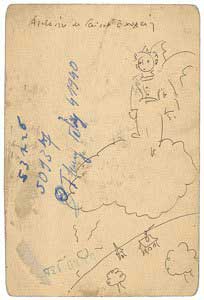
Antoine de Saint-Exupéry drawing
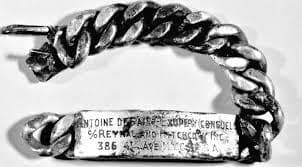
ID Card
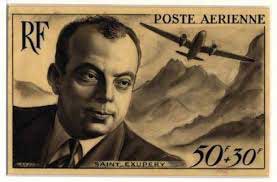
Antoine de Saint-Exupéry Stamp

Google Doodle