
Romeo & Juliet Online Course by Ross HagenPart 3 – Romeos and Juliets Abound
by Dr. Ross Hagen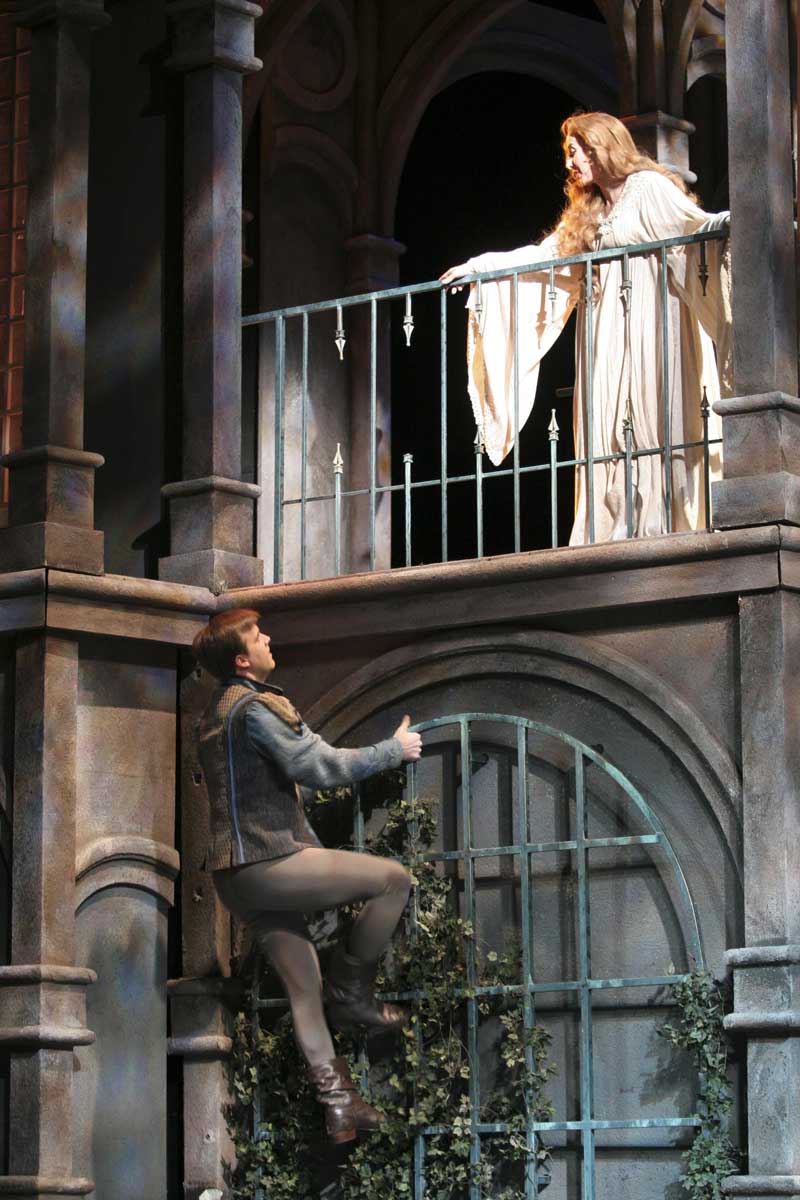
Utah Opera Company production of Romeo & Juliet, October 2005, Kent Miles
Romeo and Juliet’s omnipresence in the theaters, opera houses, and cinemas over the centuries has cemented it as THE quintessential tragic love story. The balcony scene alone has become a pervasive cultural trope for romance and seduction. Yet the ideal of romantic love depicted in the play was itself the result of centuries of development, and it of course continues to be reinterpreted and adapted according to cultural and social shifts in the centuries since its premiere. Although a full accounting of the history of love, sex, and romance in the West is completely beyond the scope of a little online lesson about opera (you might have to go to Foucault’s massive History of Sexuality for that!), we can explore some of the direct influences on Romeo and Juliet from Classical antiquity and the medieval period, consider its increasing appeal for Gounod’s audiences in the 19th century, and touch on a few 20th century adaptations.
Like most of Shakespeare’s dramas, Romeo and Juliet is itself an adaptation of existing works and the result of centuries of literary love stories and tragic romances stretching back into antiquity. Its oldest model is the myth of Pyramus and Thisbe that is included in the Roman poet Ovid’s Metamorphoses, a hugely influential narrative poem first published in the year 8 CE. Pyramus and Thisbe are young Babylonian lovers whose houses share a wall, and they whisper their love through a crack in the wall because a feud between their parents stands in the way of any marriage. They arrange to meet under a mulberry tree, but Thisbe is scared away by a lioness that has a bloody mouth from a recent kill, and she leaves her veil behind in her haste. Pyramus arrives later and upon seeing the scarf, torn and bloody from the lion, he assumes that Thisbe has been killed by a wild beast and falls on his sword. His blood splashes on some white mulberry fruits and stains them dark. Thisbe returns and finds Pyramus’ body and also commits suicide with Pyramus’ sword. In the end, the gods change the color of mulberries to dark red in order to honor their love.
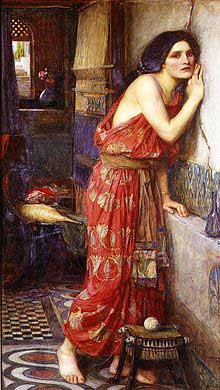
Thisbe, by John William Waterhouse, 1909.
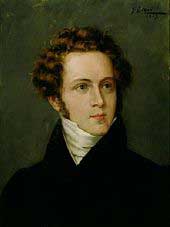
Vincenzo Bellini
Shakespeare’s appeal for Romantic era artists, authors, and composers could also be considered alongside a more general 19th-century enthusiasm for anything that could be connected with the medieval period or the Renaissance. Indeed, one of the major animating forces behind Romanticism is a pervasive sense of nostalgia, particularly for childhood but also for previous eras that were imagined to be more emotionally authentic than the present. Excellent examples of this sort of medieval nostalgia would be the Keats poem La belle dame sans merci (1819), a medievalist ballad in which a knight is seduced and fatally enchanted by a beautiful “faery’s child,” Wagner’s Tristan und Isolde, and the tendency of wealthy European landowners to erect fake ruins on their property. For Romantics, the past offered a sense of comfort and refuge from the ever confusing and complicated present, which for them would include repeated waves of democratic revolutions, the Industrial Revolution, and growing urbanization. Romeo and Juliet’s feudal and aristocratic trappings undoubtedly tapped into this nostalgia, as would many of Shakespeare’s other works, and their familiarity undoubtedly provided a sense of stability. Indeed, for those of us living in the 21st century, the past continues to be a nostalgically imagined as a place of stability and order, somehow magically free of the complexities and anxieties of Now.
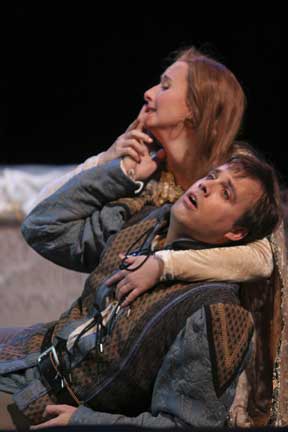
Utah Opera Company production of Romeo & Juliet, October 2005, Kent Miles
Kay, Sarah. “Courts, Clerks and Courtly Love.” In The Cambridge Companion to Medieval Romance, edited by R. L. Krueger, 81-96. Cambridge:Cambridge University Press, 2000.