
Romeo & Juliet Online Course by Ross HagenPart 2 – Grand Opera, the State, and the Market
by Ross Hagen Parisian opera in Gounod’s lifetime was a microcosm of many of the competing demands placed on the performing arts across Europe in the 19th century, most of which we still live with today. In the increasing absence of aristocratic patronage, the lofty demands of art and innovation collided with the realities of commercial entertainment’s largely conservative mindset, which greatly prefers familiarity over novelty (or perhaps, as Adorno would argue, familiarity disguised as novelty). Over the latter half of the 19th century, young composers across Europe increasingly found themselves locked in a competition with the well-worn and well-loved music of the past, a battle that they ultimately lost as the vast majority of opera houses and concert halls turned essentially into musical museums. From the management end, however, one can hardly blame the theater directors for booking the material that they know will keep the lights on. As the operatic and orchestral repertoires coalesced, the point of music criticism also became less to judge aesthetic merit (“Was it any good?”) and more to evaluate interpretations of works whose aesthetic worth had already been confirmed (“Did they play it well?”). Paris in particular also became a test case for questions over whether the state should subsidize works of art because they are in the public’s interest or whether art and music should live or die by public opinion (as measured in ticket sales). However, even if the state were to fund or otherwise encourage new works of art and music, as many composers and artists might wish, could it do so successfully without suffocating the art itself or turning it into state propaganda? By what criteria would the state evaluate works of art, especially art that much of the public might not understand or find provocative or offensive? Of course, such questions would have been largely irrelevant in the prior centuries, when most fine art and much notated music was made-to-order for use by aristocratic/royal patrons and religious institutions. Moving forward in time, by the 21st century it seems undeniable that the forces of mass-marketed capitalism have come to effectively direct the art and entertainment worlds. Universities perhaps provide some refuge for artists, poets, authors, and composers whose works have limited appeal. Paris in the 19th century, on the other hand, saw these interests collide in fascinating ways as the state experimented with ways to sustain multiple opera companies in the city and cultivate new French talent while acknowledging the demands of audiences and theater managers. The dilemmas may be nearly universal, but of course each situation has its own peculiarities. Following Napoleon’s rise to power in 1804, the number of Parisian opera houses was reduced to three that were segregated by repertoire: The Opéra for serious opera with recitative, the Opéra-Comique for operas in French with spoken dialogue, and the Théâtre-Italien for Italian opera. The Opéra at first specialized in serious opera in the vein of Christoph WIllibald von Gluck, whose dramatic style melded the traditions of Italian opera with his own preference for simplicity, naturalness, and balance between the words and the music (as opposed to the virtuosic flashiness of opera seria). In the 1830s, a new style that came to be called “grand opera” began dominating French stages with massive productions featuring huge orchestras and casts, grandiose sets and special effects, heroic and historical subjects, and lots of ballets. This style came to be associated closely with the composer Giacomo Meyerbeer, and his 1831 opera Robert le diable took Paris by storm, due in no small part to an extravagant ballet sequence featuring the ghosts of nuns rising from their graves. 1831 also saw the opera business in Paris become semi-privatized, with the state providing some funding but forcing the opera managers to rely more on public support than they had previously. In this situation, the purpose of the generic segregation between opera houses was to prevent direct competition by ensuring that the opera houses could not mount the same repertoires. However, one of the drawbacks of this entire system was that younger French composers often had a hard time breaking into the world of Parisian opera. The fact that each genre of opera had a single dedicated stage combined with the immense time and resources required to mount grand opera severely limited opportunities for performance. That the Théâtre-Italien was dedicated to imported opera made that venue essentially off limits, winnowing the available stages down to two. Recognizing the problem this created for French composers, a new opera house was founded with the specific aim of fostering French composers and mounting new operas and ballets of various types, especially innovative ones. The Opéra-National opened in 1847 but closed the following year amid financial troubles and the 1848 revolution. It was reopened in 1851 and renamed the Théâtre-Lyrique. In a lot of ways, these endeavors hoped to fulfill the promise of the Prix de Rome, which provided funding for French composers to study abroad but little in terms of support after their return. Indeed, the performance contract for the Théâtre-Lyrique specified preferential treatment for Prix de Rome winners for two years following their return and strictly limited the amount of older repertoire that could be performed. Further, no composer could have more than six works presented in a given year, which would prevent a single composer from dominating the repertoire in the way that Meyerbeer did the Opéra and Auber did at the Opéra-Comique. Yet as noble as this idea might be, it comes with significant risk. The fact that individual composers were able to dominate those other opera houses speaks to the French audience’s appetite for the familiar and established over the new. As Katharine Ellis points out (2009), train travel now allowed suburban and regional audiences access to these urban entertainments, and these audiences greatly preferred familiar classics or proven hits. Thus the new Théâtre-Lyrique had to balance out its risks by offering a mixture of old and new, and subsequent contracts began to slowly increase the number of established works and translated foreign operas that it staged.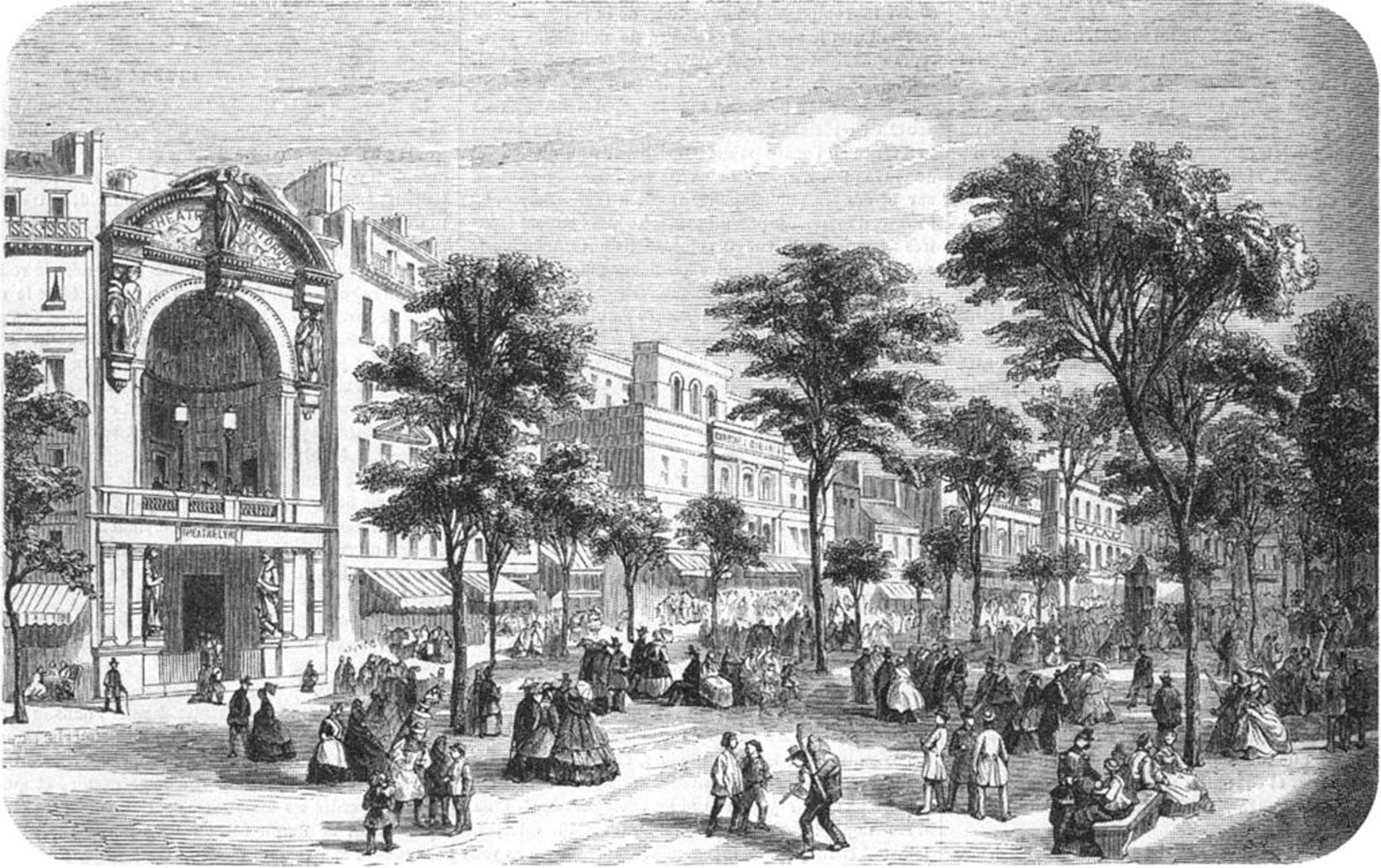
The Théâtre Lyrique on the Boulevard du Temple
In 1864, however, the Parisian theatres were deregulated entirely, allowing for new entrepreneurial operatic ventures in the city. This move had been loudly advocated by those who feared that the existing theaters, including the Théâtre-Lyrique, were closing themselves off to new French composers by focusing on established works by foreign and/or deceased composers. The idea was that a free market for operatic performance would provide more opportunities for French composers. Yet, in the aftermath of this deregulation, essentially the opposite occurred. The operatic endeavors that managed to survive did so by continuing to focus on established repertoire, while more progressive companies failed to draw sufficient audiences and quickly collapsed. Further, new forms of entertainment took hold, including operetta and the café concert, a more casual alternative to the opera house that presented lyric theater and tolerated smoking, drinking, and conversation. Ultimately, it was these lighter forms of entertainment that proved to be the more pressing danger for French operatic composers, if only because they increasingly managed to poach not only the opera companies’ audiences but also their better singers as well (Ellis 2009). Aspiring French composers might rail against their operatic institutions’ lack of support for new work, but increasing competition only made those opera houses more risk-averse in their attempts to stay afloat.
The first test case for this new state-funded operatic format was the five-act La muette de Portici (“The mute girl of Portici,” 1828), with music by Daniel-Françios-Esprit Auber and a libretto by the prolific Eugène Scribe. La muette de Portici brought together many of the components that came to define grand opera. It featured a passionate love triangle set against a historical background involving a 1647 rebellion against Spanish rule in Naples, providing a good excuse for staging huge crowd scenes. Further, in the final act a huge battle takes place amidst an eruption by the volcano Vesuvius, an opportunity to exploit the opera house’s technical capabilities. The opera is also significant because the protagonist is mute, and was therefore played by a ballerina instead of a singer (apparently due to the fact that only one dramatic soprano was available for the production, while there was no shortage of attractive and popular ballerinas). La muette de Portici also displayed a new concern with fluidity and organic continuity, particularly in its final act, which largely dispenses with the individual “numbers” that conventionally structured operatic drama. This kept the audience in suspense and increased the realism and tension, and was to have a profound effect on Richard Wagner especially.
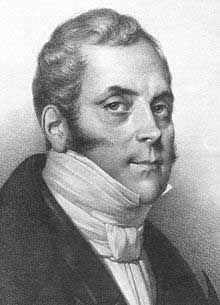
Daniel Auber
Bartlet, M. Elizabeth C. “Grand Opera.” Grove Music Online (2001) Ellis, Katharine. “Systems Failure in Operatic Paris: The Acid Test of the Théâtre-Lyrique.” In Music, Theater, and Cultural Transfer: Paris, 1830-1914, edited by Mark Everist and Annegret Fauser, 49-71. Chicago: University of Chicago Press. Fulcher, Jane. The Nation’s Image: French Grand Opera as Politics and Politicized Art. Cambridge: Cambridge University Press, 1987. Taruskin, Richard. Music in the Nineteenth Century. Oxford: Oxford University Press, 2010.