
Mahler Listening GuideSymphony no. 8 in E-flat Major
by Bettie Jo Basinger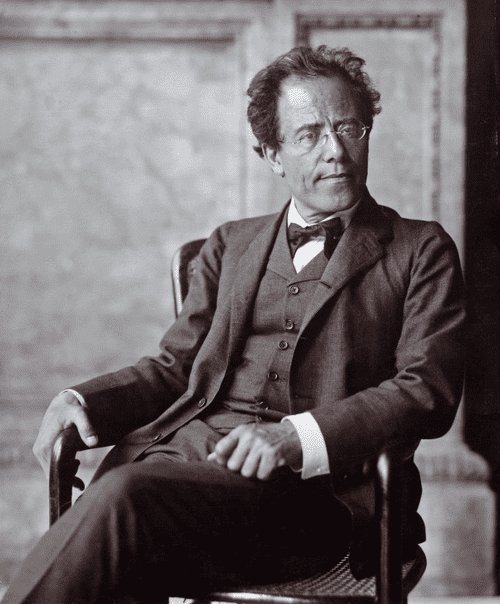
Gustav Mahler
Listening Guide for the Fist M
ovement:
Listen on Spotify
The “Symphony of a Thousand” begins with an extended sonata formsonata formmovement, and the singers carry its primary melodic materials. For this reason, Mahler considered the movement “symphonic in form,” and he described his treatment of the voices as “instrumental” to Richard Specht in 1906. Nevertheless, this Allegro impetuoso resembles a Baroque composition as much as it does a typical orchestral movement, given the prevalence of contrapuntal writing. Mahler’s recent study of J.S. Bach’s cantatas likely informed his decision to incorporate so much polyphony, as did a desire to create a work that evoked an ecclesiastical style appropriate for its text.
The main theme of the movement sets the words “Veni, veni, Creator Spiritus.” Mixed voices state it several times with orchestral punctuation before a brief transition ushers in the sonata form’s second theme. At this point, the tempo slows while a solo soprano—soon followed by the other vocal soloists—sings, dolce espressivo [sweetly expressive], “Imple superna gratia.” The choirs soon join this gracious hymn. It builds until a variation of the “Veni” motive returns, which subsequently culminates in an orchestral interlude. Soaring lines in the solo violin and vocal soloists then announce the closing theme, while brass fanfares (which the choirs promptly adopt) signal the end of the exposition.
Next, a mischievous instrumental passage initiates the development section. This lengthy interregnum works predominantly with the “Veni” material, which often appears in inversion. Before long, however, a solo bass introduces a new melody (though derived from the opening motive) on the words “Infirma nostri corporis.” A somber presentation of this theme in a minor key cedes to several major-mode restatements, until another instrumental interlude abruptly changes the mood. Then a march-like theme enters with the words “Accende lumen sensibus, ” and a brisk double fugue ultimately ensues from this procession. It, in turn, implements a protracted increase of tension. When the buildup finally peaks, the “Veni” melody resounds to herald the arrival of the movement’s recapitulation.
As typical of Mahler’s recapitulations, the materials of the exposition recur in a varied format. The composer truncates his primary (i.e. “Veni”) melody so that the second theme arrives much earlier. But Mahler also abbreviates its text and melodic content, opting instead to set the yet unheard sixth stanza of the hymn in the vocal soloists. Their musical lines derive from the “Veni” material, even though the passage concludes with text taken from the development’s march (i.e., “Pacemque dones protinus / Ductore sic te praevio / Vitemus omne pessimum”).
The orchestra alone marks the start of the coda, during which all of the movement’s important melodies reappear. The vocal soloists begin the final lines of text, which constitute a variation of the lesser doxology (i.e., the shorter of the two Catholic liturgical expressions praising God).* As brass fanfares ring out, the choirs enter above timpani rolls and organ chords. The full ensemble thus brings the movement to a brilliant conclusion.
*”Gloria Patri, et Filio, et Spiritui Sancto. Sicut era in principio, et nunc, et semper, et in saecula saeculorum. Amen.” [“Glory to the Father, and to the Son, and to the Holy Ghost. As it was in the beginning, and now, and always, and to the ages of ages. Amen.”]
Listening Guide for the Second Movement:
Listen on Spotify
Although some analysts have proposed a sonata-form layout for the finale of the Eighth Symphony, the movement’s dramatic structure makes this scheme tenuous at best, while its enormous proportions render it impossible to hear. Other interpreters view the second portion of this symphony as a large-scale construction embodying a scherzo, slow movement, and finale. Internal tempo changes support this view, as does a program that Mahler sketched during the work’s composition:
1. Hynm Veni Creator
2. Scherzo
3. Adagio Caritas
4. Hymne: die Geburt des Eros*
In the end, however, the music most closely follows the organization of Goethe’s text. Recurring melodies allow Mahler to offer his own commentary on the final scene of the Faust drama. Likewise, they afford him the means of drawing parallels with the “Veni Creator Spiritus” hymn set in the symphony’s first movement.
A ten-minute section for orchestra alone acts as the finale’s introduction. It begins with a motive that clearly relates to the “Veni” material that starts the piece, sounding both as a bass ostinato and a woodwind melody. This surrenders to a brass chorale on several occasions, though the French horn’s appasionato [impassioned] version of the opening theme will ultimately suppress the latter. When the tempo picks up, the violins play a new arching idea. Its increased rhythmic activity combines with previously-heard materials to create tension. This wanes, and the chorale reemerges, sometimes suggesting a delicate march in the woodwinds.
Beneath this gossamer accompaniment, male voices quietly enter, intoning the words of the anchorites. Yet soon the baritone solo of Pater Ecstaticus sehr leidenschaftlich [very passionately] begins an extended lyrical section. The trumpets punctuate the end of his lines with a melody associated with eternal love, just as a solo bass dramatically proclaims the words of Pater Profundus.
The motto of eternal love also sounds against Profundus’s final thoughts. The horns then restate fragments of the movement’s opening motive, while the woodwinds have ideas deriving from Ecstaticus’s passage. But this interlude proves brief, since the boys’ choir and women’s voices promptly commence simultaneous presentation of the Choruses of Angels and Blessed Boys. Both groups sing the melody associated with immortal love. Another instrumental intermezzo separates the Chorus of Younger Angels from the earlier material, and the orchestra again differentiates this assemblage from what comes next.
The More Perfect Angels—who perform against a solo viola— consist of alto and tenor voices. More importantly, these bars greatly resemble a portion of the first movement. Goethe’s text concerns Faust’s earthly remains, which the Angels find uncomfortable to carry [“Uns bieibt ein Erdenrest / Zu tragen peinlich”; “An earthly residue remains with us / Painful to bear”], while the parallel part of the first movement addresses the frailty of the human body [“Infirma nostri corporis”; “The weaknesses of our bodies”].
A looser connection also links the previously-mentioned Choruses of Angels and Blessed Boys with Mahler’s setting of “Accende lumen sensibus / Infunde amorem cordibus” [“Kindle a light in the senses / Pour love into our hearts!”]. These lines of the Gregorian hymn contain its most direct formulation of eternal love. Similarly, Goethe’s Angels speak of divine love [Und hat an ihm die Liebe gar / Von oben teilgenommen; And even Love from above / has attended him], even though the Blessed Boys mention only the generalized concept of “holiest feelings” [“Heilge Gefühle”]. Due to these textual affiliations, the “Accende” melody, in and of itself, can convey the idea of immortal love, even when played instrumentally.
Following the Chorus of More Perfect Angels (which features an alto soloist), a frisch [brisk, or crisp] rendition of the finale’s opening materials reappears as women’s voices pronounce the next lines of the Young Angels. A solo tenor, representing Doctor Marianus, first intermeshes with this group, yet his entreaties suddenly grow both more prominent and more lyrical. Instrumental statements of the “Accende”/love motive accompany many of his most poignant lines, as does a male chorus.
An interlude (consisting of varied themes already heard in the finale) prepares for the arrival of the Mater Gloriosa by means of harp arpeggios and an ethereal string melody. Doctor Marianus’s male choir completes its lines in this idyllic setting, but the Chorus of Penitent Women soon becomes the predominant sonority. The voice of Una Poenitentium, set as a soprano solo, soars above the group with a more flowing or fluid (fleißend) theme. Presently she cedes to another soprano performing the role of Magna Peccatrix, mit verhaltenem Ausdruck (with restrained expression). As this sinner seems to gain intensity, an alto singing the role of Mulier Samaritana takes the lead, yet she also relinquishes the spotlight shortly after reaching a small peak. Another alto, cast as Maria Aegyptiaca, recollects an earlier passage sung by the Chorus of Angels. The previous text contains the scene’s first mention of the penitent women; as the last of these individuals to speak, Maria Aegyptiaca therefore recalls its motivic materials. Nevertheless, Magna Peccatrix and Mulier Samaritana adopt her expansion of this melody in the ensuing three-part canon of the female penitents, as does Una Poenitentium in her subsequent solo.
Even the Blessed Boys embrace the new theme of Maria Aegyptiaca, though they interweave it with the “Accende”/love motive. However, repetition of their text coincides with a reminiscence of ideas the boys’ choir presented against Doctor Marianus’s first entrance. In the previous part, the Boys proclaim their joy upon receiving Faust’s soul in its “chrysalis form” [“Freudig empfangen wir / Diesen im Puppenstand”]; in like manner, the chorus separating Una Poenitentium’s two solos mentions that Faust “has already risen above us” [“Er überwächst uns schon”].
The “Veni” motto resurfaces in the horns near the end of Una Poenitentium’s second song. A short orchestral interlude consists of a two-fold statement of the “Accende”/love theme in the brass that serves to annunciate the Mater Gloriosa’s solo. Her dolcissimo [very sweet/delicate] lines manifest against frequent hearings of the “Accende”/love motto, played quietly, yet majestically, in solo brass instruments. A hymnenartig [hymnlike] section follows in which Doctor Marianus and his chorus requests all raise their eyes towards Heaven. Mahler introduces a new motive at this juncture, but it relates to many of his previous ideas, both rhythmically and in terms of pitch.
A compact orchestral passage—consisting primarily of the “Accende”/love motive, as well as the material associated with looking up towards Heaven—marks the start of the movement’s coda. The sounds of the organ, harp, and high woodwinds emerge to effect a serene atmosphere. The mixed choirs softly chant the words of the Chorus Mysticus in a rhythmic pattern that evokes both the opening of the present movement and the pronunciation of the word “Spiritus.” Soprano soloists unrelated to the dramatic characters surface above the combined vocal and orchestral forces, and the tension builds towards a tremendous peak. Yet Mahler prevents the movement from attaining its climax: he suddenly removes the orchestra, leaving behind a vocal chorale. This allows the composer to strive towards another apex, and at this culmination, the brass triumphantly proclaim the “Veni” motto as the Eighth Symphony quickly reaches its conclusion.
*The text Mahler intended to use for the Hymn remains unknown. However, at least one scholar has proposed the Walpurgis Night from Goethe’s Faust, zweiter Teil. In this scene, the birth of Eros results fire and water coming together.
CHOR UND ECHO (HEILIGE ANACHORETEN)
Waldung, sie schwankt heran,
Felsen, sie lasten dran,
Wurzeln, sie klammern an,
Stamm dicht an Stamm hinan.
Woge nach Woge spritzt,
Höhle, die tiefste, schützt.
Löwen, sie schleichen stumm—
Freundlich um uns herum,
Ehren geweihten Ort,
Heiligen Liebeshort.
CHORUS AND ECHO (HOLY ANCHORITES)
Forests, they sway into view;
Rocks, they rest heavily thereupon;
Roots, they cling,
Tree trunk tightly bound up with tree trunk.
Wave after wave splashes,
The deepest cave gives shelter.
Lions, they prowl around silently,
Friendly to us.
Honoring the sacred site,
Refuge of holy Love.
PATER ECSTATICUS
(auf- und abschwebend)
Ewiger Wonnebrand,
Glühendes Liebeband,
Siedender Schmerz der Brust,
Schäumende Gotteslust!
Pfeile, durchdringet mich,
Lanzen, bezwinget mich,
Keulen, zerschmettert mich
Blitze, durchwettert mich!
Daß ja das Nichtige
Alles verflüchtige,
Glänze der Dauerstern,
Ewiger Liebe Kern!
PATER ECSTATICUS
(hovering up and down)
Eternal fire of joy,
Glowing bond of Love,
Seething pain of the breast,
Sparkling delight in God!
Arrows, pierce me!
Lances, subdue me!
Clubs, smash me!
Lightning, strike through me!
That the inanities
All may evaporate.
Shine, enduring star,
Essence of eternal Love.
PATER PROFUNDUS
(tiefe Region)
Wie Felsenabgrund mir zu Füßen
Auf tiefem Abgrund lastend ruht,
Wie tausend Bäche strahlend fließen
Zum grausen Sturz des Schaums der Flut,
Wie strack, mit eignem kräftigen Triebe,
Der Stamm sich in die Lüfte trägt;
So ist es die allmächtige Liebe,
Die alies bildet, alles hegt.
Ist um mich her ein wildes Brausen,
Als wogte Wald und Felsengrund,
Und doch stürzt, liebevoll im Sausen,
Die Wasserfülle sich zum Schlund,
Berufen gleich das Tal zu wässern:
Der Blitz, der flammend niederschlug,
Die Atmosphäre zu verbessern,
Die Gift und Dunst im Busen trug:
Sind Liebesboten! Sie verkünden,
Was ewig schaffend uns umwallt.
Mein Innres mög es auch entzünden,
Wo sich der Geist, verworren, kalt,
Verquält in stumpfer Sinne Schranken
Scharfangeschlossnem Kettenschmerz!
O Gott! beschwichtige die Gedanken,
Erleuchte mein bedürftig Herz!
PATER PROFUNDIS
(in lower region)
As the rocky abyss at my feet
Rests on a deeper abyss
As a thousand resplendent brooks flow
Towards the dreadful falls of the foaming waters,
As by its own powerful urge ascending,
The tree trunk carries itself into the air:
So it is almighty Love
That shapes all things, protects all things.
Around me there is a wild boom,
As if forest and rocky ground heaved!
And still, with its tender swishing sounds,
The abundance of water pours into the gorge,
Called at once to irrigate the valley;
The lightning bolt that came down in flames
To ameliorate the atmosphere,
Carried poison and vapors in its bosom:
They are messengers of Love! They proclaim
Of what eternally creates around us.
May it also inflame my inner self,
Where my Spirit, confused and cold,
Torments itself in the confines of my dull senses,
[And the] pain of sharply-fastened chains.
O God! Calm my thoughts,
Bring light to my needy heart!
ENGEL
(schwebend in der höhern Atmosphäre,
Faustens Unsterbliches tragend)
Gerettet ist das edle Glied
Der Geisterwelt vom Bösen:
Wer immer strebend sich bemüht,
Den können wir erlösen!
Und hat an ihm die Liebe gar
Von oben teilgenommen,
Begegnet ihm die selige Schar
Mit herzlichem Willkommen.
ANGELS
(hovering in the higher atmosphere,
bearing Faust’s immortal soul)
Saved from evil is the noble limb
Of the spirit world:
Whoever constantly strives willingly
He we can redeem!
And even Love from above
has attended him,
The blessed flock meet him
With heartfelt welcome.
CHOR SELIGER KNABEN
(um die höchsten Gipfel kreisend)
Hände verschlinget
Freudig zum Ringverein!
Regt euch und singet
Heilge Gefühle drein!
Göttlich belehret,
Dürft ihr vertrauen;
Den ihr verehret,
Werdet ihr schauen.
CHORUS OF THE BLESSED BOYS
(circling around the highest peaks)
Intertwine hands
In a happy in a round-dance!
Rouse yourself and sing
The holiest feelings therein!
Divinely instructed,
Allow yourself to trust;
He who you worship
You will look upon him.
DIE JÜNGEREN ENGEL
Jene Rosen, aus den Händen
Liebend-heiliger Büßerinnen,
Halten uns den Sieg gewinnen,
Und das hohe Werk vollenden,
Diesen Seelenschatz erbeuten.
Böse wichen, als wir streuten,
Teufel flohen, als wir trafen.
Statt gewohnter Höllenstrafen
Fühlten Liebesqual die Geister;
Selbst der alte SatansMeister
War von spitzer Pein durchdrungen.
Jauchzet auf! Es ist gelungen.
THE YOUNGER ANGELS
Those roses from the hands
Of loving and holy penitent women
Helped us to achieve victory
And to accomplish the lofty work
Capturing this treasured soul.
Evil ones gave way when we scattered them
Devils fled when we encountered them.
Instead of the familiar punishments of Hell
The spirits felt the torments of Love;
Even the Master Satan himself
Was pierced through by acute pain.
Shout for joy! We are successful.
DIE VOLLENDETEREN ENGEL
(Chor mit Altsolo)
Uns bieibt ein Erdenrest
Zu tragen peinlich,
Und wär er von Asbest,
Er ist nicht reinlich.
Wenn starke Geisteskraft
Die Elemente
An sich herangerafft,
Kein Engel trennte
Geeinte Zwienatur
Der innigen beiden:
Die ewige Liebe nur
Vermag’s zu scheiden.
THE MORE PERFECT ANGELS
(Chorus with alto solo)
An earthly residue remains with us.
Painful to bear,
And even if it were of asbestos,
It is not pure.
When the strong power of the Spirit
The elements
Has seized for itself
No angel can separate
The united dual nature
Of the two intimates.
Only eternal Love
Is able to divide them.
DIE JÜNGEREN ENGEL
Nebelnd um Felsenhöh
Spür ich soeben
Regend sich in der Näh
Ein Geisterleben.
Ich seh bewegte Schar
Seliger Knaben,
Los von der Erde Druck,
Im Kreis gesellt,
Die sich erlaben
Am neuen Lenz und Schmuck
Der obern Welt.
Sei er zum Anbeginn,
Steigendem Vollgewinn
Diesen gesellt!
THE YOUNGER ANGELS
Mist-like, around the rocky heights,
I have just now sensed
Stirring nearby
A spiritual life.
I see a blessed crowd
of holy boys,
Free from earthly stress,
Assembled in a circle,
Who indulge themselves
In the new spring and adornment
of the world above.
Let him as a beginning
Of increasing perfect
Join this!
DIE SELIGEN KNABEN
Freudig empfangen wir
Diesen im Puppenstand;
Also erlangen wir
Englisches Unterpfand.
Löset die Flocken los,
Die ihn umgeben!
Schon ist er schön und groß
Von heiligem Leben.
THE BLESSED BOYS
Happily we receive
This man in chrysalis form;
Thus, we acquire
the Angelic pledge.
Unfasten loose the flakes
That envelop him!
Already he is beautiful and great
With holy Life.
DOCTOR MARIANUS
(in der höchsten, reinlichsten Zelle)
Hier ist die Aussicht frei,
Der Geist erhoben.
Dort ziehen Frauen vorbei,
Schwebend nach oben,
Die Herrliche mitterin,
Im Sternenkranze,
Die Himmelskönignen:
Ich sehs am Glanze.
Höchste Herrscherin der Welt,
Lasse mich im blauen,
Ausgespannten Himmelszelt
Dein Geheimnis schauen!
Billige, was des Mannes Brust
Ernst und zart beweget
Und mit heiliger Liebeslust
Dir entgegen träget!
Unbezwinglich unser Mut,
Wenn du hehr gebietest;
Plötzlich mildert sich die Glut,
Wenn du uns befriedest.
DOCTOR MARIANUS
(in the highest, purest cell)
Here the view is unobstructed,
The Spirit exalted.
There women are passing by
Soaring upward;
The Splendid One amidst them,
In a wreath of stars,
The Queen of Heaven,
I see it in her splendor!
Highest Mistress of the world,
Let me, in the blue
Expanse of Heaven’s canopy
Behold your Mystery!
Grant what moves the breast of a man
Earnestly and tenderly
And with the holy delight of Love
Carries it towards you!
Indomitable is our courage
When you sublimely command;
Suddenly the embers mitigate themselves
When you pacify us.
DOCTOR MARIANUS UND CHOR
Jungfrau, rein im schönsten Sinn,
Mutter, Ehren würdig,
Uns erwählte Königin, Göttern ebenbürtig.
DOCTOR MARIANUS AND CHORUS
Virgin, in the most beautiful sense,
Mother, worthy of honors,
To us, chosen Queen, equal to gods.
CHOR
Dir, der Unberührbaren,
Ist es nicht benommen,
Daß die leicht Verführbaren
Traulich zu dir kommen.
In die Schwachheit hingerafft,
Sind sie schwer zu retten;
Wer zerreißt aus eigner Kraft
Der Gelüste Ketten?
Wie entgleitet schnell der Fuß
Schiefem, glattem Boden!
CHORUS
You, the untouchable,
Nevertheless allow
Those who are easily corruptible
To come to you with familiarity.
Decimated by weakness,
They are hard to save.
Who, by his own strength,
Could tear the chains of desire?
How foot quickly the foot slips
On slanting, smooth ground?
CHOR DER BÜSSERINNEN
(und Una poenitentium)
Du schwebst zu Höhen
Der ewigen Reiche,
Vernimm das Flehen,
Du Ohnegleiche,
Du Gnadenreiche!
CHORUS OF WOMEN PENITENT
(and Una Poenitentium)
You hover in the heights
Of eternal realms;
Hear the supplication,
You, without equal,
You, rich in mercy!
MAGNA PECCATRIX
(St. Lucae VII, 36)
Bei der Liebe, die den Füßen
Deines gottverklärten Sohnes
Tränen ließ zum Balsam fließen
Trotz des Pharisäer-Hohnes,
Beim Gefäße, das so reichlich
Tropfte Wohlgeruch hernieder,
Bei den Locken, die so weichlich
Trockneten die heil’gen Glieder—
MAGNA PECCATRIX
(Luke 7:36)
By the love that at the feet
Of your divinely-transfigured Son
Let tears flow like balsam,
Despite the Pharisee’s derision;
By the vessel that so abundantly
Dripped fragrance downward;
By the tresses that so softly
Dried the holy limbs—
MULIER SAMARITANA
(St. Joh. IV)
Bei dem Bronn, zu dem schon weiland
Abram ließ die Herde führen,
Bei dem Eimer, der dem Heiland
Kühl die Lippe durft berühren,
Bei der reinen, reichen Quelle,
Die nun dorther sich ergießet,
Überflüssig, ewig helle,
Rings durch alle Welten fließet—
MULIER SAMARITANA
(John 4)
By the well, that in the past
Abraham allowed his flock to be lead to;
By the bucket that was allowed to touch
Its coolness to the lips of the Saviour;
By the pure, bountiful spring,
That gushes from there
Overflowing, ever clear,
Flows around through all worlds—
MARIA AEGYPTIACA
(Acta Sanctorum)
Bei dem hochgeweihten Orte,
Wo den Herrn man niederließ,
Bei dem Arm, der von der Pforte,
Warnend mich zurückestieß,
Bei der vierzigjähr’gen Buße,
Der ich treu in Wüsten blieb,
Bei dem seligen Scheidegruße,
Den im Sand ich niederschrieb—
MARIA AEGYPTIACA
(Acts of the Saints)
By the immensely consecrated place
Where the Lord was laid to rest;
By the arm that from the entrance,
Warningly thrust me back;
By the forty years’ penance
That I faithfully abided in the deserts;
By the blessed last farewell
That I wrote down in the sand—
ZU DREI
Die du großen Sünderinnen
Deine Nähe nicht verweigerst
Und ein büßendes Gewinnen
In die Ewigkeiten steigerst,
Gönn auch dieser guten Seele,
Die sich einmal nur vergessen,
Die nicht ahnte, daß sie fehle
Dein Verzeihen angemessen!
THE THREE
You, who to greatly sinful women
Do not dent your proximity;
And one who raises the benefits of repentance
Into eternalness,
Also grant to this good soul,
Who only once forgot itself,
Not suspecting he was doing wrong,
Your commensurate forgiveness!
UNA POENITENTIUM
(sonst Gretchen genannt, sich anschmiegend)
Neige, neige,
Du Ohnegleiche,
Du Strahlenreiche,
Dein Antlitz gnadig meinem Glück!
Der früh Geliebte,
Nicht mehr Getrübte,
Er kommt zurück.
A PENITENT
(formerly called Gretchen, approaching closely)
Turn, turn—
You, without equal,
You, radiant one—
Your face graciously upon my happiness!
The early beloved,
No longer marred,
He is coming back.
DIE SELIGE KNABEN
(in Kreisbewegung sich nähernd)
Er überwächst uns schon
An mächtigen Gliedern,
Wird treuer Pflege Lohn
Reichlich erwidern.
Wir wurden früh entfernt
Von Lebechören;
Doch dieser hat gelernt,
Er wird uns lehren.
THE BLESSED BOYS
(approaching in a circling movement)
He already rises above us
On mighty limbs;
The wages of faithful care
He will richly return.
We were removed early
From living choirs;
Yet this one has learned:
He will teach us.
DIE EINE BÜßERIN
(sonst Gretchen genannt)
Vom edlen Geisterchor umgeben,
Wird sich der Neue kaum gewahr,
Er ahnet kaum das frische Leben,
So gleicht er schon der heiligen Schar.
Sieh, wie er jedem Erdenbande,
Der alten Hülle sich entrafft
Und aus ätherischem Gewande
Hervortritt erste Jugendkraft!
Vergönne mir, ihn zu belehren:
Noch blendet ihn der neue Tag!
A PENITENT
(formerly called Gretchen)
Surrounded by a noble choir of spirits,
The newcomer is hardly aware of himself;
He scarcely senses the fresh Life
As he already resembles the holy flock.
See how he, from all earthly bonds
Of his old husk, breaks free,
And from the ethereal garments
Emerges the first strength of youth appears!
Allow me to instruct him:
He is still dazzled by the new day
MATER GLORIOSA
Komm! Hebe dich zu höhern Sphären!
Wenn er dich ahnet, folgt er nach.
MATER GLORIOSA
Come! Raise yourself to higher spheres!
When he senses you, he will follow.
DOCTOR MARIANUS UND CHOR
(auf dem Angesicht anbetend)
Blicket aut zum Retterblick,
Alle reuig Zarten,
Euch zu seligem Geschick
Dankend umzuarten!
Werde jeder bessre Sinn
Dir zum Dienst erbötig!
Jungfrau, Mutter, Königin,
Göttin, bleibe gnädig!
DOCTOR MARIANUS AND CHOIR
(prostrate in her presence)
Raise your eyes to the gaze of the Redeemer
All you repentant frail ones,
You will in gratitude transform yourselves
to attain a blessed fate!
Let all good sense
Be ready to serve you!
Virgin, Mother, Queen,
Goddess, remain merciful!
CHORUS MYSTICUS
Alles Vergängliche
Ist nur ein Gleichnis;
Das Unzulängliche,
Hier wird’s Ereignis;
Das Unbeschreibliche,
Hier ist’s getan;
Das Ewig-Weibliche
Zieht uns hinan.
CHORUS MYSTICUS
Everything ephemeral
Is only metaphor;
The insufficient
Here becomes an event;
The indescribable
Here is done;
The eternal feminine
Draws us upwards.