
Mahler Listening GuideSymphony no. 7 in E Minor / C Major
by Bettie Jo Basinger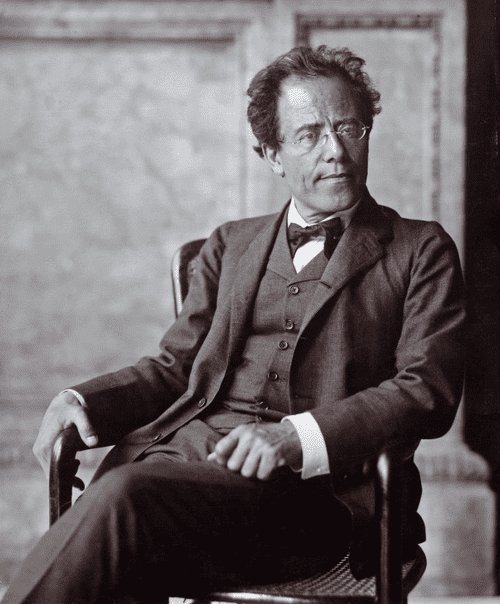
Gustav Mahler
Listening Guide for the First Movement:
Like the openings of many of Mahler’s orchestral works, Symphony no. 7 commences with a slow introduction. This one establishes a solemn mood through the use of funeral-march rhythms and the unexpected timbre of a tenor horn—a German instrument closely related to the American baritone horn. The melody played by the tenor horn proves malleable: Mahler constantly varies its pitches and displaces its rhythms as he passes the material to other instruments. In this way, the composer prepares the principal theme of movement, which enters after the march-like character of the introduction intensifies and the speed accelerates.
A German tenor horn
The main body of movement follows a loose sonata-form design, which begins at an Allegro con fuoco (i.e., with fire) tempo. The exposition presents three primary ideas. First, the horns state a new tune—comprised of figures taken from the introduction—over a driving accompaniment in a minor key. Next, a switch to the major mode ushers in “espressivo” (“expressive”) violins playing sweeping gestures “mit großen Schwung” (“with great impetus”). Finally, brass and woodwinds enter to brilliantly affirm a major-key variant of the “fuoco” theme before the minor mode intrudes once more.
The return of the minor mode coincides with restatement of both the home key and the movement’s principal melody (i.e., the “fuoco” material). However, the music soon moves into other tonal areas and begins to freely combine themes in a manner consistent with a sonata-form development. Mahler works with ideas deriving from the introduction, the “fuoco” melody, and the “großen Schwung” theme while constantly modifying key, tempo, volume, and orchestral timbre. But suddenly the orchestra halts, and a trumpet fanfare quietly announces a chorale.
This brief hymn recalls the Knaben Wunderhorn (The Boy’s Magic Horn) poem “Urlicht” that Mahler set in his Second Symphony. Nothing in the Seventh’s first movement has prepared the listener for the hymn’s serene affect, and—perhaps for this reason—its calm proves short-lived. It soon cedes to a pastoral section for double reeds and solo violin. Yet following this interlude, trumpet fanfares signal a reappearance of the chorale, and this time, its “Urlicht” recollections lead to a lush climax. Here the violins intone the “großen Schwung” melody above harp arpeggios while the brass quietly sounds the “fuoco” theme in the background. Gradually the level of dissonance increases as the volume builds; ultimately, the music peaks, and Mahler then reprises the movement’s introduction.
A sonata-form recapitulation normally does not incorporate the return of an introduction (though exceptions to this rule extend at least as far back as Beethoven, with the first movement of the Piano Sonata in C minor, Op. 13 “Pathètique” of 1798 serving a clear example). Mahler’s varied restatement nonetheless provides a necessary bridge between the development and the reappearance of his primary theme. The introduction’s material reestablish the somber mood that prevailed at the beginning of the movement, and this supplies a better launching point for the “fuoco” start of the recapitulation than would the idyllic atmosphere heard at the movement’s apex.
As in the exposition, the fiery temperament of the main melody dissipates for the “großen Schwung” material. This soon gives way to a march-like version of the primary theme, which quickly becomes militaristic as the music surges towards its coda. This final section begins with another martial push, but dramatic arpeggios (briefly in tonic major) soon bring the movement to a close.
Listening Guide for the Second Movement:
An Allegro moderato comprises the Seventh Symphony’s first Nachtmusik movement. It begins with a French horn duet alternating in a call and answer arrangement, and Mahler instructs the responding horn use a mute. This scoring evokes the pairing of English horn and offstage oboe in the “Scène aux champs” (“Scene in the Fields,” or “Scene in the Country”) of Berlioz’s Symphonie fantastique, especially since the oboe and English horn timbres clearly emerge in the ensuing interplay between the various woodwind instruments.
But Mahler did not incorporate this reference to Symphony fantastique as a mere homage. In the program for “Scène aux champs,” the protagonist muses about his beloved while listening to shepherds piping in the countryside. Thus, Berlioz’s movement unfolds, at least within the world of its program, in nature. Mahler also desires an outdoor setting for the Allegro moderato of Symphony no. 7, since this would link the movement to the eighteenth-century tradition of Nachtmusik. By alluding to the music of “Scène aux champs”¬—and by extension, its program—Mahler can place his second movement in the same environment.
The materials mentioned thus far belong to the Allegro moderato’s introduction, and the aforementioned woodwinds coalesce into birdsong. (Mahler will mark these materials “wie Vogelstimmen”—”like birdcalls”— in the movement’s coda.) Light articulation and trills permeate their lines, though the texture thickens as more instruments join in. However, the major-minor motto of the Sixth Symphony soon interrupts in order to signal the start of the movement proper.
Overall, the Allegro moderato proceeds as a march that flanks two contrasting trios. The primary melody derives from the horn dialogue that opened the movement, and initially, its character manifests only when rhythmic accompaniment (played “col legno”—”with the wood” of the bow— by the violins) intermittently appears. The processional qualities of the music nevertheless intensify, even as hints of the birdsong periodically surface. For this reason, the movement’s identity as a march becomes unmistakable by the time the first trio arrives.
Although this trio retains the march’s tempo and meter, it possesses a contrasting disposition; so too does the second trio. In the former, the broad melodic lines of the cellos resemble the popular music of Mahler’s day, while the accompanying triplets impart a dance feel. The latter, on the other hand, conveys a pastoral lyricism through the prevalence of woodwind timbres, frequent trills, and drone harmonies. The composer further distinguishes the trios from the march through occasional recollections of his First and Third Symphonies; in contrast, the march does not recall any other works, whether by Mahler himself or a different composer.
Restatement of the march—preceded by the introduction’s horn duet, this time with offstage cowbells—separates the first trio from the second, and varied presentation of the birdsong (culminating with the major-minor motto of the Sixth Symphony) bisects the latter. Then the sections heard up to this point in the Allegro moderato return in reverse order: The second trio moves to the march, which then cedes to a reappearance of the first trio. This, in turn, leads to the final hearing of the march. Finally, the materials of introduction resurface in a coda that culminates in the major-minor motto before the music fades out.
Listening Guide for the Third Movement:
Although Mahler did not designate the third movement as Nachtmusik, the “schattenhaft” (“shadowy”) indication he affixed to the score suggests that this scherzo has a nocturnal disposition. The composer evokes this character through muted strings and glissandi, as well as through the “klagend” (“lamenting” or “wailing”) melody replete with sighing figures. Yet this atmosphere does not persist for the entire movement. Like the rest of the Seventh Symphony, the scherzo incorporates a considerable amount of contrast.
The movement subdivides into the typical tripartite layout expected of scherzos, with variety attained by means of a trio sandwiched between two statements of the primary material. However, Mahler creates even greater diversity with a playful waltz that appears within both scherzo sections. Initiated by a sweeping leap in the violins, the graceful melodic line and um-pah-pah rhythms of this dance offer temporary respite, though the scherzo’s shadowy mischief always returns.
Even the trio section cannot escape the movement’s devilry. It begins with a “dolce espressivo” (“sweet,” “expressive”) oboe duet set against drone harmonies, but swirling figuration in the flutes and solo violin soon disrupt this pastoral calm. A solo viola then strikes up another dance, made somber by the thin orchestration and descending melodic line. As more instruments join the cotillion, the speed increases, and the music becomes distorted until a lyrical theme in the horns and cellos somehow emerges from the din.
The scherzo nevertheless resurfaces, cutting off this lyricism. At first, the final presentation of its materials proceeds as before: Mahler establishes the dark atmosphere, the “klagend” idea recurs (now in the violins), and then the waltz arrives—as do the trio’s motives. In other words, the composer synthesizes all of his melodies, rather than simply restating the waltz. This results in an animated feel, yet because he parodies many of his themes, Mahler simultaneously caricatures his own music. The movement consequently ends with its mischievous nature intact.
Listening Guide for the Fourth Movement:
In correspondence dating as early as 1904, Mahler refers to the Seventh Symphony’s fourth movement as a serenade (as opposed to the Nachtmusik designation that appears on the score). This appellation acknowledges the movement’s plucked accompaniment alternately played by harps, strings, guitar and mandolin. Likewise, it embraces the Andante amoroso (“loving” or “affectionate”) tempo indication, which combines with the aforementioned instruments to suggest a lover accompanying himself while he sings beneath the stars. Mahler also may have modeled the movement on Wagner’s Siegfried Idyll of 1870, a serenade performed at the Wagner home for the composer’s wife on the occasion of her 33rd birthday.
The form of this serenade resembles the preceding scherzo: two presentations of the main melody surround a central trio. However, in this movement Mahler inserts a developmental restatement of the primary theme between its first hearing and the trio. Furthermore, the trio materials do not interpenetrate the final appearance of the serenade as they did in the last scherzo segment. The resultant form, then, reduces to AA’BA (or, serenade – development of serenade – trio – serenade).
In the opening bars of the movement, the violins perform an “espressivo” motive, “mit Aufschwung” (“with upswing”), that will return several times in the serenade sections as a closing gesture. A “zart hervortretend” (“gently prominent”) horn melody, placed above plucked lines in the harp, soon follows. It too recurs in a manner resembling a refrain fashion, always set against bird-like gestures in the woodwinds that recall the earlier Nachtmusik movement. Between these ideas, the violins present short lyrical and “graziosissimo” (“the most graceful”) interludes.
Repeated low notes mark the beginning of the developmental portion of the fourth movement. In this section, Mahler fragments and manipulates both the “zart” and “graziosissimo” materials. The mandolin timbre periodically surfaces, and the music begins to modulate, taking the movement into minor keys. This creates tension, as do the low register and occasional changes in tempo.
The trio commences with a broad, descending theme played by solo horn and cello. This songlike melody appears twice, with its second statement rising to a peak. Harp arpeggios sound as the gesture subsides, and in the quiet that ensues, fragments in the oboe and horn suggest that the trio’s descending theme will repeat once more. Instead, the violins enter “mit Aufschwung,” reiterating the opening of the movement.
This, in turn, indicates the reprise of the serenade. All of its materials now come back in varied guises. Yet this time the “graziosissimo” melody rises to a dramatic fortissimo that briefly evokes the Adagietto of Mahler’s Fifth Symphony. Similarly, the subsequent passages—marked “etwas dränged” (“somewhat urgent”), “aufgeregt” (“excited” or “agitated”), and “sehr fließend” (“very flowing”)—accelerate, building as if the movement is hastening towards its climax. Nevertheless, the original tempo abruptly returns, as does the initial mood. These persist until the serenade dissipates, leaving only the birdcalls and plucked chords to quietly end the movement.
Listening Guide for the Fifth Movement:
Mahler identifies the last movement of Symphony no. 7 as a “Rondo-Finale.” This implies that its main theme will frequently return in the home key. However, this designation neither acknowledges the complexities of the movement’s form, nor indicates the unexpected ways in which the composer manipulates the rondo’s primary materials. For example, the movement’s main themes do alternate with secondary sections in the manner of a rondo. But Mahler weaves in developmental statements of his principal motives, and his development subjects these ideas to disruptive changes in tempo and meter that seem atypical of rondo form.
At the beginning of the finale, the composer establishes a pattern of stating the so-called “refrain” (i.e., the main portion of a rondo form), moving to a contrasting “episode,” and then presenting a variation of the refrain. In theory, three of these sequences occur; two further hearings of the refrain then follow before a coda concludes the movement. A summary of this scheme would appear as ABA’ ABA’ ABA’ AA coda (A = refrain; B = episode; A’ = development of the refrain).
Unfortunately, this tidy scheme does not hold up in practice. By the third occurence of the movement’s refrain, Mahler no longer remains in the home key for the entire presentation of its materials. Yet in traditional rondo form, a refrain must remain in tonic; if it does not, then the passage does not constitute a true refrain. Thus, an analyst could also interpret this finale as ABA’ ABA’ A’BA’A’ A’ coda.
After a brief but bombastic introduction, the initial refrain includes three motives, as well as a culminating fanfare, that will dominate the remainder of the movement. First, the trumpets sound a brilliant chorale in broad rhythms. Next, the French horns continue the hymn with an allusion to the overture from Wagner’s Die Meistersinger von Nürnberg (1867), and Mahler will employ this material as an independent idea as the movement proceeds. Finally, the violins in their low register emerge with an animated yet stately version of the chorale. This, in turn, leads to the aforementioned fanfares, which derive from the introduction’s timpani line.
An oboe duet now introduces a new melody, thereby delineating the rondo’s first episode. Here Mahler creates a pastoral atmosphere, and he evokes the bucolic scene with the same devices he used in the pastoral moments of the previous movements: wind duets, woodwind trills, and static harmonies. The oboe motive repeats and expands into a fuller theme. It weaves throughout the orchestral fabric, quickly gaining intensity. The growth proves fleeting, however, and it promptly cedes to the Meistersinger paraphrase.
Although the composer places the Meistersinger motive in the home key, he soon moves into foreign tonal regions. Once there, Mahler begins to treat his melodic materials with tremendous freedom. For example, he activates the rhythm of the stately variant of the chorale while scoring it for strings, woodwinds, and timpani in a decidedly eighteenth-century manner. This transformation later adopts a triple meter and a “grazioso” (“graceful”) affect, as well as a novel—though related—countermelody.
A short “pesante” (“heavy” or “ponderous”) phrase nevertheless dispels the lightness of the previous passages, preparing the listener for the return of the refrain. The composer wends through all of its motives with only slight alteration. In contrast, the second episode undergoes much greater modification. Set in the minor mode, the oboe melody transfers to the darker-sounding English horn, and a Rute (i.e., twig or switch) strikes the side of the bass drum to provide accompaniment. Exaggerated accents and abrupt changes in dynamics briefly distort the music before Mahler finally restores the pastoral calm of the first episode.
A sudden reduction of the orchestral forces marks off the next section of the movement. Here the strings play a fragment of the episode, and the brass answers with the Meistersinger material in a distant tonal area. Mahler immediately corrects this “mistake,” and after a short pause, reintroduces the eighteenth-century version of the chorale. Once again, the composer imposes a triple meter and “grazioso” character on this melody as he channels it through a variety of keys. But this time, Mahler inserts a short phrase in a fast tempo to temporarily disrupt the progress of the theme.
Likewise, another unanticipated switch to a fast tempo prevents the “grazioso” transformation from attaining closure. This interruption ushers in an alternation of expansive chords and running figuration in the strings that reestablishes the home key. A greatly modified and compressed refrain ensues, with the stately violin material resurfacing only in its eighteenth-century guise. When the original form of this melody finally emerges, Mahler has moved into a new key. He now develops the theme by setting it against other motives, including the chorale and timpani line that opened the movement.
This developmental treatment of refrain materials quickly yields to the final episode. Despite a few hints of darkness, as well as the uniqueness of flutter-tonguing flutes (i.e., rolling the letter r while still blowing into a wind instrument), this segment of the movement possesses the pastoral qualities of its predecessors. Mahler’s subsequent handling of refrain motives, on the other hand, greatly diverges in the remainder of the movement. In addition to incorporating a near quotation of Janissary music* from Mozart’s 1782 opera Die Entführung aus Serail [The Abduction from the Seraglio], K. 384—a work that a features an onstage serenade sung to plucked string accompaniment—the composer entwines all of the finale’s melodies, as well as recalling the first movement’s main theme. The tempo changes no fewer than nine times, and the meter also fluctuates. Brass timbres predominate, and as the final moments of the piece approach, bells resound to bring Symphony no. 7 to a luminous conclusion.
*Music purporting to emulate military bands that accompanied the Janissaries, elite soldiers of the Ottoman Empire.