Tosca’s Historical Background
by Paul Dorgan In Puccini’s opera Tosca, the first character we meet on-stage is an escaped prisoner. When the painter Mario Cavaradossi recognizes him shortly afterwards, he greets him thus: “Angelotti! The Consul of the defeated Roman Republic!” To quote Supreme Court Justice Antonin Scalia in a recent dissent: “Say what?” Surely, thinkest thou, the Roman Republic, with its Consuls, existed in some vague time B.C. Thou wouldst be right. It dideth. And verily the Roman Republic endethed with the arrival of Julius Caesar and his establishment of the Roman Empire. To what, then, was Cavaradossi referring? Bear with me! Victorien Sardou, whose play La Tosca was adapted for Puccini’s opera, wrote historical dramas: at least the ones he tailored to Sarah Bernhardt’s talents were. This particular one is set in Rome, June 1800. Given the actual battles which form an important element of his plot, Sardou could have been more specific with the actual date in June, but maybe we should be thankful he didn’t, as it’s about the only historical detail he spared us!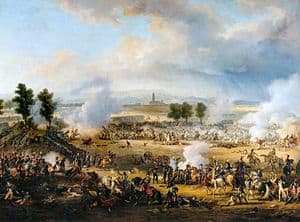
Battle of Marengo by Louis-Francois Lejeune
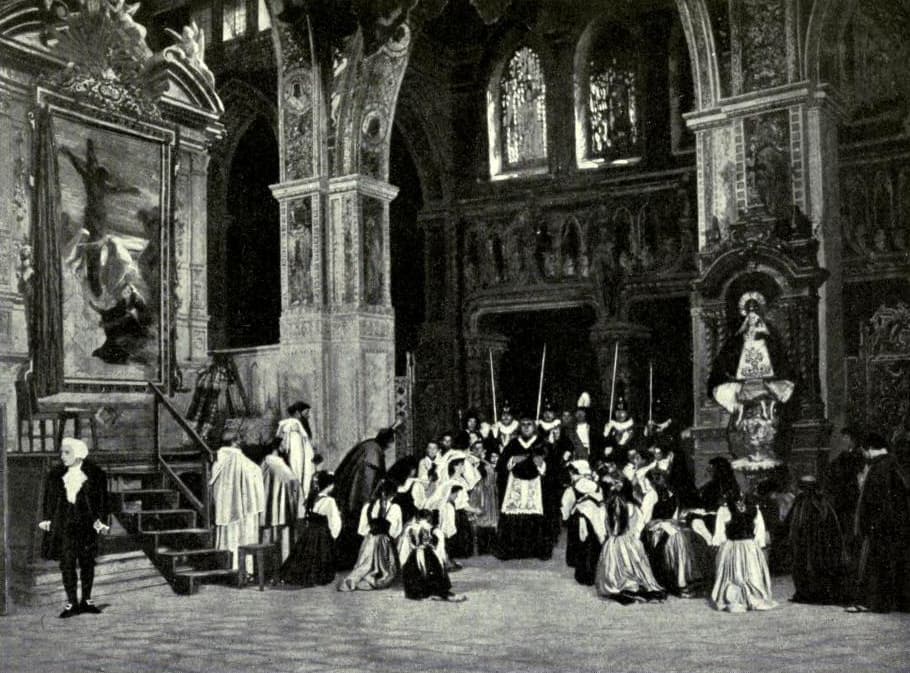
Te Deum
In her Act One duet with Cavaradossi, Tosca tells him she must perform that night, but it’s a “quickie,” and she will soon be home with him. The “quickie” is explained when the Sacristan returns with the joyful news of Bonaparte’s defeat, which is to be celebrated, he says, with a specially-composed cantata to be sung by the great Floria Tosca at a gala in the Palazzo Farnese; churches, including his, will sing hymns of praise. The great Te Deum that ends Puccini’s first act is indeed a masterly celebration of joy. One of the unique wonders of Opera is that two, or more, contrasting/conflicting ideas/emotions can be expressed, quite clearly, at the same time. Here is a perfect example: while the people are singing the Catholic hymn of joy, Baron Scarpia, the Chief of the Roman Police, sings of his lust for Tosca. A stunning musical moment!
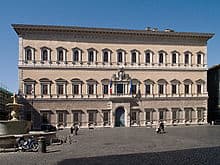
Palazzo Farnese
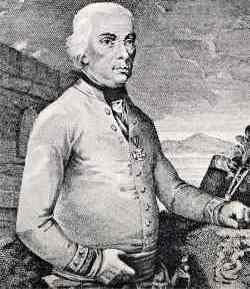
General Melas
On June 4, the French forces did surrender to General Melas; that news arriving in Rome, and told us by the Sacristan, prompted the “Te Deum” we heard at the end of Act 1, and the “quickie” cantata for Tosca we heard from off-stage early in Act 2. But Bonaparte, with his army, was on the move. Hoping to figure out exactly where the enemy was, he split his forces into three and arrived with his division on the plain of Marengo on June 14, where he came upon the Austrians. Melas was so confident of victory over the hopelessly outnumbered French that he relinquished his command to a subordinate and returned to the nearest city, Alessandria, to announce his triumph. No sooner had he left the field than one of Napoleon’s earlier-divided French units arrived on the scene. The rejuvenated French army forced the Austrians to retreat and the next day Melas agreed to withdraw from Northern Italy.
It is this reversal of the Austrian forces that Sciarrone reports to Scarpia. And, of course, your grandparents would have discussed, over dinner, the Battle of Marengo. Right? Maybe the grandparents, or even the parents, of the audience at the Teatro Costanzi in Rome on January 14, 1900, did talk to their children about that battle, and about that Roman Republic, and about that long struggle for Italian Unification, which included sometimes horrific repression of any hint of pro-French leanings among the natives – i.e. the Italians. So perhaps the librettists felt justified in their ruthless excision of everything “unoperatic” – Sardou’s detailed expositions of his principal characters – forgetting, or ignoring, that later audiences (should the opera be a success) would have no historical frame of reference for the plot. Maybe they assumed (hoped?) that Puccini’s music, like Bonaparte, would carry the day. Given the popularity of the opera with audiences and singers over the past 115 years, they were right. But surely Floria Tosca is more than everyone’s idea of a temperamental soprano who gets trapped in some diabolical political web? And isn’t Mario Cavaradossi more than a painting tenor who gets trapped in that same diabolical web? And isn’t Baron Vitellio Scarpia more than just the spider who wove that diabolical web? Yes. All are more – shall we say “three-dimensional”? – than the librettists allow them to be. To support my claim, I’ll call Sardou’s script to the witness-stand, use it (in W. Laird Kleine-Ahlbrandt’s translation), then rest my case and turn judgement over to you, the readers and audience, as jury! At the outset, let me freely admit that Victorien Sardou was no Racine, no Molière, no Beaumarchais, nor even a Hugo: those great masters whose plays had given Sarah Bernhardt her greatest successes as an actress. Nor do any of Sardou’s heroines come anywhere close to those of his authorial parents/grandparents! But in their reducing of the playwright’s La Tosca into the libretto for Puccini’s Tosca , the central characters have been boiled down to a bland trio: a jealous Diva; a passionate Tenor who loves said Diva; which love is thwarted by the evil Baritone. Let’s start with the first character we see on stage. If you’ve read so far, Cesare Angelotti , just escaped from the notorious prison at the Castel Sant’Angelo, was a Consul in the short-lived Roman Republic . Was his Consulship the reason for his imprisonment? Not exactly! Twenty years previously (Sardou is specific) the wealthy young Italian, heir to a considerable estate near Naples, visited London where he met and spent a week with a prostitute. Having inherited his father’s estate, he is invited to dinner to meet the English Ambassador to the Kingdom of Naples, Sir William Hamilton and his wife, Lady Emma, who happens to be the mistress of Admiral Horatio Nelson, whose British Naval Fleet controls the Mediterranean. Turns out Lady Hamilton once was Emma Lyon – his London whore. Recognizing each other, she pressures the Neapolitan Monarchy to investigate anyone suspected of French sympathies; Angelotti’s house is raided and two books by Voltaire are found (planted, he claims) resulting in three years in the galleys. Having served that sentence he, impoverished, ends up in Rome, becomes a Consul in that city’s short-lived Republic, is arrested after the city’s surrender to the Neapolitans in 1799, and thrown into Sant’Angelo. His sister, the Marchioness Julia Attavanti, has spent a year arranging his escape. Is it a, to use a George Bernard Shaw pejorative, Sardoodle-ish coincidence that Angelotti would, in the Church where is the Attavanti Chapel, run into a politically sympathetic ally? Of course! Many of Sardou’s plays hinge on such coincidences. As do so many others! What a coincidence it is, for example, that King Duncan decides to spend the night at Macbeth’s castle: the very night that Lady M’s ambition has been sparked by the news of her husband’s encounter with the Weird Sisters! And that very special handkerchief Iago manages to acquire which proves to be the downfall of Desdemona?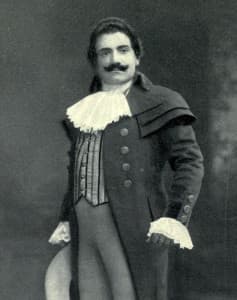
Caruso as Cavaradossi
Who is Angelotti’s politically sympathetic ally? And why is he in a Church whose outer doors are always locked during siesta-time? He is Mario Cavaradossi, who is painting, free of charge, a mural of Mary Magdalene. The operatic Sacristan’s mutterings of his “Voltaire-ean” tendencies don’t register because they are mumbled under the expansive tenor phrases of Cavaradossi’s first aria; and even if the supertitles include those lines, are we aware of their political significance in the Rome of 1800 I doubt it.
Back to Sardou. Eusebius, who becomes Puccini’s nameless Sacristan, disparagingly calls the painter a Frenchman. The painter’s young assistant objects, saying the Cavaradossi family is an old Roman patrician family; but, replies Eusebius, his mother is not merely French, but Parisian! That she was, and it was in Paris that the young, wealthy Nicolas Cavaradossi was introduced to Diderot’s circle of “Encyclopedists” (considered revolutionary),where he met and married Mademoiselle de Castron. Their French-born-and-educated son Mario, studied with the great painter Jacques-Louis David, an early supporter of the French Revolution. With both parents dead, he returned to Rome in 1799 to settle some business matters; he met Floria Tosca, the famous singer, and decided to remain in the city. His lengthy stay in the city has aroused suspicion. His French title – Chevalier, inherited from his father – for starters. Then the fact that his teacher, David, was a member of the committee which condemned the French king to death. In a city which politically approved of clean-shaven men wearing powdered wigs, knee breeches and buckled shoes, Cavaradossi’s short hair, his beard and mustache, and his boots mark him as “an extreme liberal…a free thinker…a revolutionist.” He also – horrors! – reads Voltaire and Rousseau. His painting of the mural in this Church offers him some security while he pursues his affair with La Tosca. The star of the major Italian Opera Houses – Sardou lists them all – Floria Tosca was born far from the glittering social circles in which she now moves. A goatherd (but not a yodeling one), she was taken in by a convent of nuns who taught her to read and to pray; she discovered music on her own, encouraged by the convent’s organist. People soon flocked to the nuns’ church on Feast Days to hear her sing. The composer Domenico Cimarosa was one of those and determined she should be an opera singer. The nuns felt that such a career would send her to Hell, and the argument climbed through the hierarchy all the way to the Pope who, after listening to her sing, consented to her release from the convent. Around the age of 20 she made a triumphant début in Nina, an opera by Giovanni Paisiello, who appears in the second act of Sardou’s play. Politically she is a Royalist, supporting the Monarchy. Religiously she is a devout Catholic who regularly consults her Father Confessor. She seems, though, to have come to terms with the fact that, according to her Confessor, her affair with Mario means she lives in mortal sin and will go to Hell should she die, which would be OK because he’ll be there with her.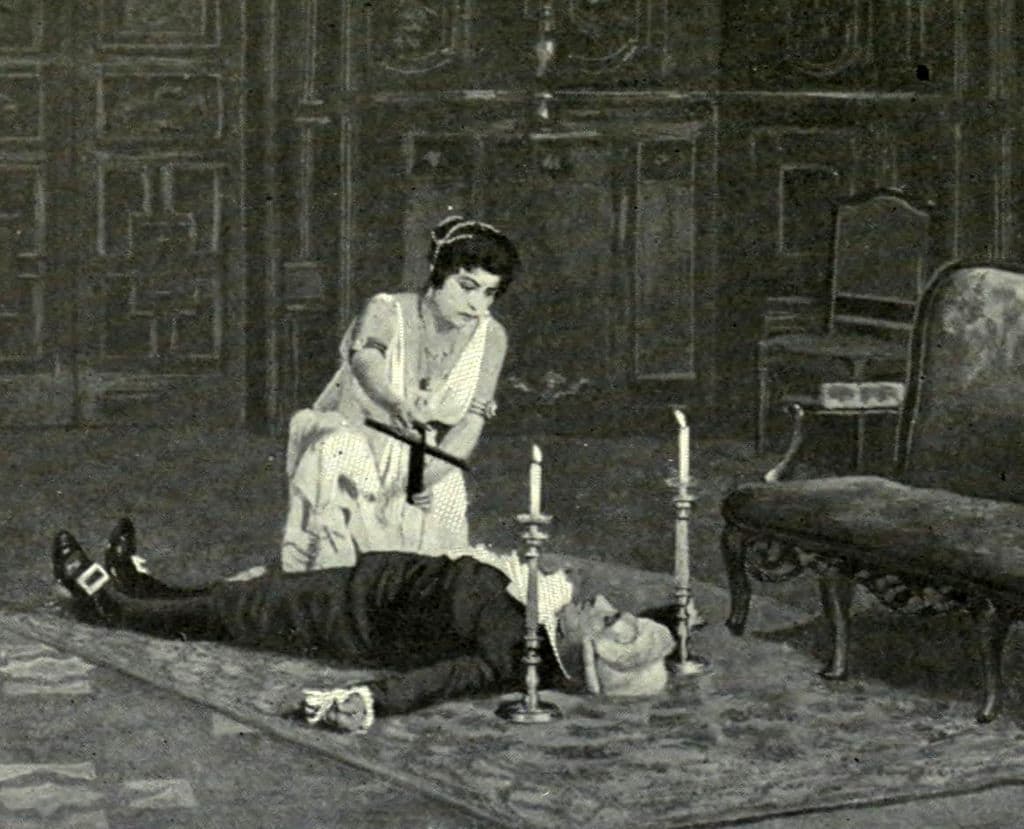
Tosca and Scarpia