
Mahler Listening GuideSymphony no. 3 in D Minor
by Bettie Jo Basinger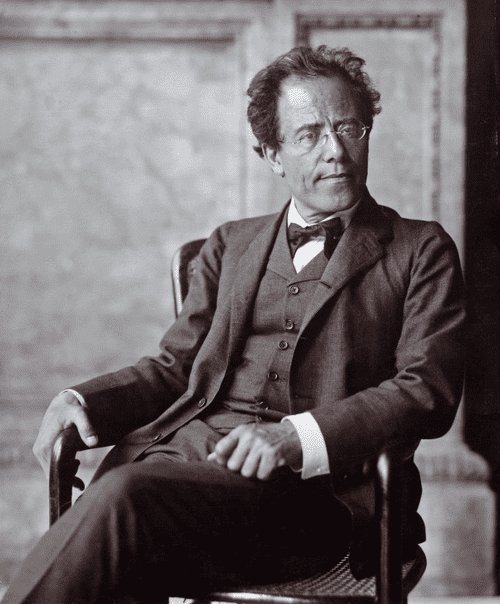
Gustav Mahler
Work History
In terms of its metaphysical “content,” Symphony no. 3 in D Minor has a complicated history, even though Mahler composed the piece in a relatively short amount of time. He commenced work with the second movement during June of 1895, and he had finished this movement, together with the subsequent ones, by the end of that summer. Yet despite this seemingly quick pace, the composer struggled with how to order these movements, as well as whether to include as a seventh, “Das himmlische Leben” (“The Heavenly Life”) of 1892, a Lied based on a text drawn from the folksong collection Des Knaben Wunderhorn (The Boy’s Magic Horn). Because he planned to unify the symphony by basing the music of the first movement on this same Wunderhorn song, Mahler necessarily delayed its completion until he decided what would serve as the work’s finale. Thus, the opening movement, which incorporates two march-like themes possibly written as early as 1893, remained as sketches until the summer of 1896. At this time, the composer had rejected the idea of a seventh movement, and “Das himmlische Leben” would wait to become a symphonic movement until Mahler wrote his Fourth Symphony.
“Das himmlische Leben”
Im himmlischen Keller,
Die Englein, die backen das Brot.
Gut’ Kräuter von allerhand Arten
Die wachsen im himmlischen Garten!
Gut’ Spargel, Fisolen
Und was wir nur wollen!
Ganze Schüsseln voll sind uns bereit!
Gut Äpfel, gut’ Birn’ und gut’ Trauben!
Die Gärtner, die alles erlauben!
Willst Rehbock, willst Hasen,
Auf offener Straßen
Sie laufen herbei!
Sollt’ ein Fasttag etwa kommen,
Alle Fische gleich mit Freuden angeschwommen!
Dort läuft schon Sankt Peter
Mit Netz und mit Köder
Zum himmlischen Weiher hinein.
Sankt Martha die Köchin muß sein.
Kein’ Musik ist ja nicht auf Erden,
Die uns’rer verglichen kann werden.
Elftausend Jungfrauen
Zu tanzen sich trauen!
Sankt Ursula selbst dazu lacht!
Cäcilia mit ihren Verwandten
Sind treffliche Hofmusikanten!
Die englischen Stimmen
Ermuntern die Sinnen,
Daß alles für Freuden erwacht.
We enjoy heavenly pleasures,
Therefore we avoid earthly things,
No worldly tumult
Does one hear in Heaven!
All live in the gentlest peace.
We lead an angelic life!
Still we are very merry!
We dance and leap,
We hop and sing!
Saint Peter in Heaven watches!
John lets go of his little lamb,
The butcher Herod waits!
We lead a patient,
Innocent, patient,
A lovely little lamb to death!
Saint Luke slaughters the oxen
Without much thought or attention.
The wine costs not a penny
In the heavenly cellar.
The angels, they bake the bread.
Good vegetables of every type
They grow in the heavenly garden!
Good asparagus, beans
And whatever we want!
All dishes are fully prepared for us
Good apples, good pears, and good grapes!
The gardeners, they allow everything!
Do you want roebuck, do you want hare?
On open streets
They come running up
Should a fasting day by chance come
The fish immediately swim up with joy!
There Saint Peter is already running
With net and bait
To the heavenly pond.
Saint Martha must be the cook.
No music on earth
That can be compared to ours.
Eleven thousand virgins
have the courage to dance!
Saint Ursula herself laughs as well!
Cecilia and her relatives
Are splendid house musicians!
The angelic voices
Rouse the senses
So that all awaken with joy.
“Das irdische Leben”
“Mutter, ach Mutter! es hungert mich!
Gib mir Brot, sonst sterbe ich.”
“Warte nur, mein liebes Kind,
Morgen wollen wir backen geschwind.”
Und als das Korn geerntet war,
Rief das Kind noch immerdar:
“Mutter, ach Mutter, es hungert mich!
Gib mir Brot, sonst sterbe ich!”
“Warte nur, mein liebes Kind,
Morgen wollen wir dreschen geschwind.”
Und als das Korn gedroschen war,
Rief das Kind noch immerdar:
“Mutter, ach Mutter! es hungert mich!
Gib mir Brot, sonst sterbe ich.”
“Warte nur, mein liebes Kind,
Morgen wollen wir backen geschwind.”
Und als das Brot gebacken war,
Lag das Kind auf der Totenbahr.
“Mother, oh Mother, I’m hungry!
Give me bread , or I shall die!”
“Just wait, my dear child,
Tomorrow we will bake quickly.”
And once the corn was harvested
The child wailed again:
“Mother, oh Mother, I’m hungry!
Give me bread, or I shall die!”
“Just wait, my dear child,
Tomorrow we will thresh quickly.”
And once the corn was threshed,
The child wailed again:
“Mother, oh Mother, I’m hungry!
Give me bread , or I shall die!”
“Just wait, my dear child,
Tomorrow we will bake quickly.”
And once the bread was baked,
The child lay on the funeral bier.
Mahler’s Version of Ablösung im Sommer
Kuckuck hat sich zu Tode gefallen
An einer grünen Weiden,
Kuckuck ist tot! Kuckuck ist tot!
Wer soll uns jetzt den Sommer lang
Die Zeit und Weil’ vertreiben?
Ei! Das soll tun Frau Nachtigall!
Die sitzt auf grünem Zweige;
Die kleine, feine Nachtigall,
Die liebe, süße Nachtigall!
Sie singt und springt, ist all’zeit froh,
Wenn andre Vögel schweigen.
Wir warten auf Frau Nachtigall,
Die wohnt im grünen Hage,
Und wenn der Kukuk zu Ende ist,
Dann fängt sie an zu schlagen!
Cuckoo has fallen to his death
On a green willow.
Cuckoo is dead! Cuckoo is dead!
Who now should the summer long
Pass the time for us?
Well! Mrs. Nightingale should do it!
She sits on green branches:
The small, delicate nightingale,
The dear, sweet nightingale!
She sings and leaps, is happy at all times,
When other birds are silent.
We wait for Mrs. Nightingale,
She resides in green groves,
And when the cuckooing is over
Then she starts to blow

A nineteenth-century German post horn, currently on display at the Spandau Citadel in Berlin.
“Father, look at my wounds! Let no creature be lost!” Now do you understand, my dear, what we are speaking of here? It is the zenith, the highest level that the world can be viewed from. I could also name the movement something like “What God Tells Me,” in the sense that God can only be comprehended as “love.”In this regard, then, “What love tells me” epitomizes the loftiest position in the chain of being’s ranking. For this reason, the movement renders “Das himmlische Leben” unnecessary as the finale to the Third Symphony: though its discussion of heaven’s abundance fits Mahler’s evolutionary scheme, the Wunderhorn Lied proves redundant since the sixth movement has already addressed the highest level of existence. Had the composer elected to retain “Das himmlische Leben” as a seventh movement in Symphony no. 3, however, then it too would have received a programmatic title. As a letter to the historian and archeologist Fritz Löhr dated 29 August 1895 indicates, at one time Mahler intended to name this planned finale “What the Child Tells Me.” And this designation would not negate the movement’s placement at the end symphony, since “the child” metaphorically stands at the uppermost position of the great chain of being, at least if Mahler found inspiration in the 1883-1885 philosophical manifesto Also sprach Zarathustra (Thus spoke Zarathustra) by Friedrich Nietzsche (1844-1900). The second portion of “Zarathustra’s Vorrede”, for instance, reveals—via a conversation between Zarathustra and an aged saint—that Nietzsche’s title character possesses child-like attributes, as well the ability to love the human race as a whole. In contrast, the saint loves only God; because he finds the human race “too imperfect,” he cannot love mankind. Thus the child-like figure emerges as one with a greater capacity for love. He embraces a greater number of beings—and does so despite their flaws. This behavior, due to its accepting and benevolent nature, seems more “godly” to Mahler. Despite the compatibility between the projected “What the Child Tells Me” title, the placement of the movement within in the programmatic enactment of the great chain of being, and Also sprach Zarathustra —not to mention the heavenly imagery of “Das himmlische Leben,” which becomes innocent hyperbole when seen through the eyes of a child—only circumstantial evidence connects this particular portion of Symphony no. 3 to Nietzsche’s book. Yet the text of the fourth movement attests to an unquestionable link between them. The words delivered by an alto soloist here appear as the so-called “Mitternachtslied” (“Midnight Song”) that concludes two chapters of Also sprach Zaraustra: “Das andere Tanzlied” (“The Other Dance Song”) and “Das trunkene Lied” (“The Drunken Song”; also called “Das Nachtwandler-Lied” or “The Nightwanderer’s Song”). This text warns the human race of the woes of earthly existence, promising joy only in eternity [see translation provided with the Fourth Movement Listening Guide below]. It therefore can represent humankind in the chain of being—as Mahler’s proposed designation for the movement, “What Humankind Tells Me,” acknowledges. Evidently the composer believed that his Third Symphony shared enough thought with Nietzsche’s ideology that he considered naming the entire work Die fröhliche Wissenschaft (literally The Happy Science, but traditionally translated as The Gay Science) after the philosopher’s book of 1882 (rev. 1887). Although Mahler also contemplated the designation Das glücklich Leben: Ein Sommernachtstraum (nicht nach Shakespeare) (The Happy Life: A Midsummer Night’s Dream [Not After Shakespeare]), the title referencing Nietzsche came later in the development of the work’s program, and it persisted longer—even as it went through alteration and personalization like Meine fröhliche Wissenschaft (My Happy Life). This last version better affirms the individuality of the intricate web of meanings that the composers weaves together through his textual choices, musical quotations, and sequence of movements than does exact replication of Nietzsche’s title. After all, Mahler’s beliefs hardly reproduce the philosopher’s, especially in terms of religion. Nothing in Symphony no. 3 suggests that the composer upheld the notorious (if misconstrued) slogan “Gott ist todt” (“God is Dead”) that Nietzsche reiterates three times in Die fröhliche Wissenschaft (“Neue Kämpfe”/”New Battles,” “Der tolle Mensch”/”The Madman,” and “Was es mit unserer Heiterkeit auf sich hat”/”The Meaning of our Cheerfulness”) and twice more in Also sprach Zaraathustra (“Zarathustra’s Vorrede”/”Zarathustra’s Prologue” and “Von der schenkenden Tugend”/”From the Bestowing Virtue”) Approximate Time in performance: 90-100 minutes Instrumentation: 4 flutes, with all alternating on piccolos; 4 oboes, with 1 alternating on English horn; 3 clarinets, with 1 alternating on bass clarinet; 2 E-flat clarinets, one being the clarinet/bass clarinet player; 4 bassoons, with 1 player alternating on contrabassoon8 French horns; 4 trumpets, with the possibility of reinforcement of two parts at times; 4 trombones; Tuba; 6 timpani, played by two percussionists; 2 glockenspiels; Tambourine; Tam-tam; Triangle; Suspended cymbals; Side drum; Bass drum with cymbal attached, sometimes played with Rute (i.e., switch) stricking the wood; 4-6 tuned bells, placed in a high gallery; 2 harps; Violins; Violas; Cellos; Basses, some with low C extension; Alto solo; Women’s choir, placed in a high gallery; Boys’ choir, placed in a high gallery
Listening Guide for the First Movement
As noted above, Mahler considered assigning the programmatic appellations “Pan Awakens” and “Summer Marches In” to the introduction and main body of the first movement of his Third Symphony (respectively). These designations symbolized the awakening of nature to the composer, and he revealed this metaphor in a June 1896 conversation with Bauer-Lechner about the work’s opening: “It is eerie, how out of lifeless matter (I could just as well have named the movement ‘What the Mountains Tell Me’) life gradually breaks forth, developing step-by-step into ever-higher forms of life: flowers, animals, human beings, up into the realm of spirits, to the angels.” Yet in Mahler’s opinion, a season cannot change without overcoming the hardships of the previous months. In other words, summer must triumph over winter. Thus, the composer had stated to Bauer-Lechner during the previous summer: “Naturally, this does not happen without a battle against the opponent Winter, but he is overconfident and easily dispatched; and Summer, in his strength and superior power, soon prevails.” For this reason, struggle, victory, and the suggestion of growth permeate the first movement. The piece begins with a fanfare played at by all eight horns (in unison) at a loud volume. Since this tune references the melody of the German student song “Wir hatten gebauet ein stattliches Haus” (“We Had Built a Stately House”; text added by Daniel Augst von Binzer to a traditional melody in 1819), it sounds familiar even to many first-time listeners, if only (for American audiences) because Brahms incorporated it in his Akademische Festouverture (Academic Festival Overture), Op. 80 of 1880. Mahler’s version differs significantly from Brahms’s in terms of character, however. In Symphony no. 3, the composer designated the melody as “Der Weckruf” (“the alarm call”) on his autograph, thereby identifying the passage as a call to arms within the upcoming programmatic skirmish between summer and winter. On the last held note of the horn call, the bassoons and trombones enter with some of the primary materials of the fourth movement, which the horns (in their lower register) elaborate. Bass drum strokes then lead into a funeral march, marked “schwer und dumpf” (“heavy and stifling”) on the score. Motivic fragments in the bassoons and muted trumpets sound throughout this passage, as do rising cries in the woodwinds. But none truly resemble a full melody, though recitative-like gestures in the low strings ultimately extend into melodic exchanges between the horns and trumpets. The drum strokes reappear, this time delineating the start of a playful passage that Mahler initially labeled “Pan schläft” (“Pan Sleeps “). Light woodwind chords introduce a jaunty oboe melody at the head of this section, and the tune transfers to viola and later clarinets (the latter labeled “Der Herold!” [“The Herald”] on the composer’s autograph). Rumbling low strings round off this passage before the funeral march returns, this time with a trombone recitative sounding above it. After a few more taunts from the muted trumpets, the funeral march cedes to a resumption of the “Pan schläft” material, which now bubbles over into a quiet march marked “wie aus weiter Ferne” (“from far away”). A less aggressive “Wir hatten gebauet,” as well as the bouncy “Pan” tune, file past multiple times—and sometimes simultaneously. So too do numerous brass fanfares. The volume increases as the procession approaches, and the music builds until a surprising change of key abruptly halts the march’s forward progress. At some point during the “wie aus weiter Ferne” march, Mahler moved from the introduction into the exposition of a sonata from [insert link to definition of sonata form movement. No obvious demarcation segregates the introductory and expositional sections into discrete entities; instead, the continuity of the march binds them together, and their shared motivic materials (i.e., “Wir hatten gebauet,”the “Pan schläft” melody, and the march) cement this bond. In contrast, the unexpected key change heard just before the halfway point of the movement clearly separates the development from the portions of the movement that precede it. Moreover, it heralds the arrival of a stormy recurrence of the recitative in all eight horns, which trumpets answer before a brief yet triumphant fanfare (accompanied by a ringing triangle) resounds. Mournful, sighing lines follow in the trombone and English horn before the violin presents a variation of the “Pan schläft” melody. Soon a second statement of the march—this time given the indication “wie aus weitester Ferne” (“from furthest away”)— briefly returns before an “ausdrucksvoll” (“expressively”) reiteration of the “Pan” tune in a solo horn ushers in a lyrical section. But this proves short-lived. Cellos and basses restate the march, over which the high woodwinds introduce shrill figuration. Mahler originally labeled this passage as “Das Gesindel!” (“The Riff-Raff”), and he explained what this association meant to Bauer-Lechner during the summer months of 1895: ” . . . I need a regimental band to attain the rough and crude effect of my martial company’s arrival. It will be just like the military band on parade. Such rabble milling around, you never saw anything like it!” The addition of brass motives and shaking tambourine creates a busy texture comparable to the hubbub of Mahler’s imagery, though the percussion ultimately announces that—to use the wording of Mahler’s autograph—”Die Schlacht beginnt” (“The Battle Begins”). Here the trombones state “Wir hatten gabauet” beneath the march played on piccolo and E-flat clarinet. After a short reply in the horns and drum, the trombones resume the charge, driving forwards until swirling string figures begin a portion of the movement that the composer initially labeled “Der Südstorm” (“the south storm”). Snatches of various motives weave in and out of this tempest. Ultimately, though, it subsides, and the snare drum beats a military cadence in order to marshal in the recapitulation. Here the materials of the beginning of the movement reappear in roughly the same order (though condensed). Atypically, though, Mahler chooses to recapitulate the gestures of his introduction, including “Wir hatten gebauet” as a “Weckruf” and the funeral march in combination with a trombone recitative. The sighs now occurring at the end of the recitative evoke the short yet sorrowful gestures of the development, and a last statement of the march—now marked “wieder Alles aus weitester Ferne sich nähernd” (“again all approaching from furthest away”)—now enters. Again, “Wir hat gebauen” and the “Pan” melody materialize above the march; first each sounds separately, but as the parade comes closer, the composer presents them against one another with greater frequency. Tension builds, but this time the march reaches its zenith on a chord without a jarring shift into a new key. And in response to this achievement, a brilliant fanfare emerges to conclude the movement.Listening Guide for the Second Movement
Mahler marked the second movement of this symphony as a minuet, as well as indicating that its opening material should have a “grazioso” (“graceful”) character appropriate for this kind of dance. The layout of the movement as a pattern of two alternating dances (i.e., minuet-contrasting dance-minuet etc.) also illustrates the typical form of the minuet genre. Yet use of the minuet had become anachronistic by the end of the nineteenth century, since Beethoven’s symphonies had initiated a trend of replacing them with other dance types, especially the scherzo. And while many modern commentators describe the central dances sandwiched between the minuet sections of this movement as “scherzos,” the combination of these two dance types proves highly unconventional. Within the first minuet section, the composer organizes his material in a tripartite a b a pattern. He begins with an oboe playing the main melody (a) over pizzicato strings, and then other instruments (violas, clarinet, and oboe again) expand upon its gestures. Next, the central portion of the minuet (b) commences with the violins stating a faster-moving idea over harp accompaniment. Other instruments enter—though trumpet and cello timbres in particular emerge from the orchestral fabric— before the opening melody (a) recurs in the violins. A sudden change to a faster tempo and minor key delineates the start of the initial scherzo. This portion of the movement proceeds as a series of contrasts: Not only does it commence with a markedly different sound than the minuet, but within approximately 30 seconds, the meter switches from a three-beat pattern to one based on a march-like two beats. This, in turn, lasts a mere 15 seconds before the triple meter resumes for the fastest music of the movement, accompanied by a return of the major mode and whirling figuration in the oboes and clarinets. Towards the end of this passage, the flutes evoke the setting of “Das himmlische Leben” that Mahler at one time considered using as the seventh movement of the present symphony. The minuet sneaks back in halfway through its main melody (a). Aside from this, its reappearance continues as before, though with some alterations to instrumentation. Similarly, the reiteration of the scherzo exhibits some modification. For example, Mahler elongates the march-like passage, and at the reemergence of the major mode, he combines its ideas with those of the march. Perhaps because the composer works with more materials here, he extends this portion of the movement. Nevertheless, variants of the opening materials resurface for the minuet’s final restatement, and this completes the movement.Listening Guide for the Third Movement
Due to the indication “Comodo. Scherzando. Ohne Hast” (“at ease; playfully; without haste”) appearing above its opening measures, most musicians understand the third movement of Mahler’s Symphony no. 3 as a large-scale scherzo. Like the preceding minuet’s design, it has contrasting central sections, and this attribute of the third movement’s form conforms to historical norms. Nevertheless, Mahler’s internal sections have little resemblance to dance music, and this proves atypical of scherzos. The movement does demonstrate the humor associated with the genre, however: as previously stated, a great deal of its material consists of an orchestral transcription of the Wunderhorn Lied “Ablösung im Sommer,” and the score of Mahler’s original setting of this text for voice and piano bears the marking “Mit humor” at its head. When generating the symphonic movement, Mahler may have omitted this annotation, but his use of orchestral color (especially in the high woodwinds) actually serves to heighten the playful character of the music. Both the symphonic and vocal-piano versions have a minor-major-minor organization that corresponds to the imagery of the poem: the cuckoo’s death (minor), the nightingale taking its place (major), and presumably—since no text accompanies this portion of the song—a reminder of the cuckoo’s fate (minor). After completing this sequence, the composer then extends the scherzo section by alternating “Ablösung’s” materials with other dance types. First a gigue-like idea appears, and then a polka emerges from brief references that Mahler had formerly embedded within the cuckoo’s melody. As this occurs, the instrumentation thickens and the volume increases to build intensity. When the tension finally breaks, the full orchestra plays a descending chromatic scale that ostensibly represents the cuckoo falling to its demise. At this point, the nightingale resumes its song, though now the clarinets interject a fragment of “Das irdische Leben” above it. As the scherzo draws towards its end, the call of a muted trumpet surfaces as a means of preparing the first of the movement’s internal episodes. The calm, pastoral atmosphere that now materializes dramatically diverges from the animated activity of the “Ablösung” section. Here, Mahler’s autograph requests that a post horn play a lilting shepherd dance, though he initially wrote the part for muted trumpet, switched the instrument to flugelhorn, and only then settled upon the obscure post horn. (Most modern performance use either flugelhorn or muted trumpet, though the Boston Symphony Orchestra has resurrected the post horn for recent performances. The melody emerges “wie aus weiter Ferne” (“from far away”), though at times the composer requests it sounds “sich etwas nähernd” (“becoming somewhat nearer”). This, not to mention Mahler’s final instrument choice, resonates with Leanau’s aforementioned poem, as its postilion imagines the echoes of his own post horn as the answering calls of a deceased friend. Despite an unsuccessful attempt to derail the post horn episode, the scherzo manages to return only after the pastoral melody runs its course. Thus, the “Ablösung” materials resurface with a more anxious mien. Now marked with “mit geheimnissvoller Hast!” (“with mysterious haste”), the polka rhythms permeate the opening portion of this section, and then a “grob!” (“course”) variation of the nightingale’s music appears against a reiteration of the gigue. Yet the frenzied energy cannot sustain itself. The post horn, “in weiter Entfernung” (in the far distance”) restores calm. But convention requires that the opening material also closes scherzo movements. Mahler therefore has to bring in “Ablösung in Sommer” one more time. The abrupt appearance of a chord foreign to the key (a technique the composer also used in the symphony’s first movement) signals a violent outburst, after which a brass recitative and ebullient fanfare ensue. As the final seconds of the movement approach, the satirical nature of the scherzo distorts the fanfare, though hints of triumph remain audible.Listening Guide for the Fourth Movement
The fourth movement of Symphony no. 3 sets the “Mitternachtslied” of Nietzsche’s Also sprach Zarathustra at a soft volume: the music proceeds so quietly, in fact, that the dynamic level never rises above piano. Within this hushed framework, Mahler presents an economy of musical materials that nevertheless inform the rest of the song. For example, the oscillating steps that begin the movement in the low strings shape the melodic motion of many subsequent motives. Likewise, the rising thirds of unequal size harmonizing the alto soloist’s two-fold utterance of the opening motto “O Mensch!” (“O humankind!”) return in various guises. Finally, these same germinal thirds—which Mahler anticipates in the first movement’s introduction—fluctuate between major and minor sonorities, and this modal ambiguity characterizes much of the fourth movement’s music. At the next phrase of text, “Gib Acht!” (“Pay attention!), the voice abbreviates the oscillating steps into a sighing figure, and a pair of horns—harmonizing in the thirds of the “O Mensch” motive—soon extends the gesture into a longer melody. The alto then sings the following line (“Was spricht die tiefe Mitterernach?” / “What does deep midnight say?”) in tandem with the horn duet, but on the last note, the music suddenly shifts into a minor key. Approximately one quarter of the movement has now passed, and the oboe demarcates this structural subdivision with the rising thirds of the “O Mensch” motto. The remainder of the first half of the movement parallels this sequence of musical events: vocal sighs lead to horns moving stepwise in close-knit thirds, and ultimately, the oboe—marked “wie ein Naturlaut” (“as a sound of nature”)—enters with the “O Mensch” motive to mark off the middle of the song. In this second quarter of the movement, however, Mahler traverses the pattern twice, with an English horn (playing the oboe’s rising motive) heard between them. Elements of the orchestration also change, and few of the motives reappear without some kind of modification. But the composer breaks from Nietzsche’s model in order to repeat the words “O Mensch!” midway through the text. Perhaps to articulate this newly-formed textual refrain, Mahler resurrects the oscillating steps and rising unequal thirds in their original forms. Even so, this central portion of the movement still exhibits alteration of the primary musical materials. A solo violin, for instance, comes in immediately prior to the oboe’s rising thirds, and a single horn answers them as well. Mahler assigns an “espressivo”(“expressive”) indication to this violin solo, and the lyricism it imparts persists for the rest of the song. The vocal line takes on shorter rhythms and a greater number of slurred articulations. Similarly, the horns have rhythmically-active, sweeping lines, even as their duet expands into a quartet. Eventually, though, the oboe’s call returns, and the oscillating steps resume as the movement fades away. The fourth movement should move directly into the fifth without break.“Mitternachtslied” from Nietsche’s Also sprach Zarathustra
Oh humankind! Pay attention!
What does the deep midnight say?
“I was sleeping, I was sleeping¬¬!
I awoke from a deep dream:
The world is deep,
and deeper than the day conceived!
O humankind! O humankind!
Deep is its woe!
Pleasure—deeper still than heartache.
Woe speaks: Fade away!
But all pleasure wants eternity—
wants deep, deep eternity!”
Oh humankind! Pay attention!
What does the deep midnight say?
“I was sleeping, I was sleeping¬¬!
I awoke from a deep dream:
The world is deep,
and deeper than the day conceived!
O humankind! O humankind!
Deep is its woe!
Pleasure—deeper still than heartache.
Woe speaks: Fade away!
But all pleasure wants eternity—
wants deep, deep eternity!”
Listening Guide for the Fifth Movement
Although the fifth movement of Mahler’s Third Symphony comprises a setting of the Wunderhorn text “Es sungen drei Engel” (“Three Angels Were Singing”), the composer enriches this folk poem through the addition of his own words. The bulk of them appear in the boys’ choir, which simply repeats the syllables “bim bamm” as an emulation of the sound of bells. To the women’s chorus, on the other hand, Mahler assigns affirmative restatements of thoughts expressed by the alto soloist. The actual text of “Es sungen drei Engel” gets distributed between the women’s chorus and alto. Because this poem proceeds as a conversation between angels and St. Peter, Mahler subdivides his performing forces in a manner that represents the angels and saint through the women’s chorus and alto soloist respectively. This choice obviously disregards Peter’s gender: however, the use of an alto links this movement with the previous one. It also places the dialogue in the women’s and children’s voices, and this parallels the conversation described in “Das irdische Leben,” another Wunderhorn song quoted (instrumentally) in the third movement. Bell-like tones (and text) in the boy’s choir open the movement, and the woodwinds quickly enter with a hymnal melody. Soon thereafter, the women’s choir join in, singing the “Es sungen drei Engel” text to a faster-moving tune that periodically slows down to enunciate important names like Petrus (Peter) and Herr Jesus (Lord Jesus). All of this occurs in a bright major key as a reflection of the “Freuden” (“joy”) described by the angels. The strings materialize only at the start of the movement’s contrasting central section. The alto appears, singing an extended quotation of the music that will become the setting of “Das himmlische Leben” in the finale to Mahler’s Fourth Symphony. Here, the composer places the material against pleading cries in the oboe, and this pairing, especially when combined with the minor key, signals a darker character. The boys’ choir too adds to the more reserved mood by contributing fewer bell tones. At key lines of text—most notably “Ach komm und erbarme dich über mich!” (“Oh come and have pity on me”)—the texture abruptly thins in order to call attention to the words, as well as to evoke the sounds of a prayer. After this happens for the second time, the references to “Das himmlische Leben” cease. The music also becomes increasingly distorted as stopped horns, muted trumpet, striking dissonances, and the ominous timbre of the tam-tam emerge from the orchestral din. Yet because the angels feel assured of Peter’s salvation, the major key and bell-like sounds of the boys’ choir suddenly return as if the preceding section had not occurred. The women’s chorus now presents a stately version of its initial material, and on occasion, the boys even drop their “bim bamm” to join in. Once again, Mahler chooses to highlight specific phrases of the text: for “Liebe nur Gott in alle Zeit! (“Love only God at all times!”), the orchestra drops out so that the women’s choir may sing these words a cappella. Just before the movement closes, the trombones have a prominent entrance. The composer means for this passage to evoke the long-standing association between this instrument and church music in German-speaking countries (as in, for example, the Tuba mirum of Mozart’s Requiem, K. 626). The high brass nevertheless soon take over, and these instruments cede to the bells (both literal and vocal) as the movement concludes. Mahler indicates that the fifth movement should continue directly into the sixth, without break.“Es sungen drei Engel”/”Armer Kinder Bettlerlied”
Es sungen drei Engel einen süßen Gesang:
Mit Freuden es selig in den Himmel klang,
Sie jauchzten fröhlich auch dabei,
Dass Petrus sei von Sünden frei,
Und als der Herr Jesus zu Tische sass,
Mit seinen zwölf Jügern das Abendmahl ass:
Da sprach der Herr Jesus: “Was stehst du den hier?
Wenn ich dich anseh’, so weinest du mir.”
“Und sollt’ ich nicht weinen, du gütiger Gott.?”
“Ich habe übertreten die zehn Gebot.
Ich gehe und weine ja bitterlich.
Ach komm und erbarme dich über mich!”
Hast du denn übertreten die zehen Gebot,
So fall auf die Knie und bete zu Gott!
Liebe nur Gott in alle Zeit!
So wirst du erlangen die himmlische Freud’,
Die himmlische Freud, die selige Stadt,
Die himmlische Freud, die kein Ende mehr hat.
Die himmlische Freude war Petro bereit’t,
Durch Jesum und Allen zur Seligkeit.
Three angels sung a sweet song:
With joy it blissfully sounded in Heaven.
They happily rejoiced as well
That Peter was free from sin,
And when Lord Jesus sat at the table,
With his twelve disciples, ate the evening meal:
There the Lord Jesus spoke: “Why do you stand here?”
When I look at you, you cry for me.”
“And shall I not weep, you gracious God?”
I have violated the Ten Commandments.
I go and weep bitterly.
Oh come and have pity on me.”
You have then violated the Ten Commandments,
Thus fall on your knees and pray to God!
Love God at all times!
Thus you will attain heavenly joy,
Heavenly joy, the blessed city,
Heavenly joy that has no end!
Heavenly joy was given to Peter,
Through Jesus and everyone at salvation.