
Mahler Listening GuideSymphony no. 2 in C Minor (“Resurrection”)
by Bettie Jo Basinger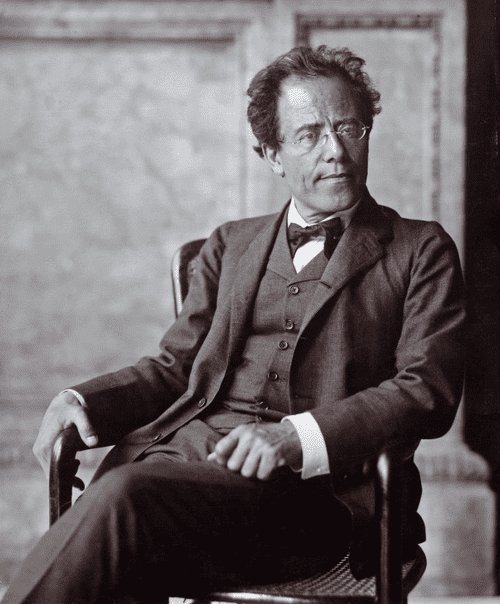
Gustav Mahler
Work History
Mahler composed his Second Symphony over a period of seven years. He began the first and second movements in January of 1888, around the same time that Die drei Pintos—a comic opera left unfinished at death by Carl Maria von Weber that Mahler had taken on the task of completing in 1887—premiered in Leipzig. Although his work on the second movement Andante yielded only a few melodies, the composer managed to draft the first movement in a mere ten months. Nevertheless, 1889 presented him with a series of tremendous setbacks. Mahler’s father, mother, and sister Leopoldine all died within a few months of one another, and an unfavorable response met the premiere of his First Symphony on 20 November 1889. Perhaps for these reasons—not to mention the demands of the conducting position he then occupied at the Hungarian Royal Opera—Mahler put aside all composition. He did not return to the project that would become Symphony no. 2 until the summer months of 1893. During the intervening years, the composer would not only relocate from Budapest to Hamburg in order to take up a conducting position at the latter’s Stadttheater (City Theater), but attempt to have the first movement performed and published as an independent symphonic poem entitled Todtenfeier (Funeral Rites).
Resumption of work on the Second Symphony coincided with the composer’s continued interest in Des Knaben Wunderhorn (The Boy’s Magic Horn) settings as early as 1887. He commenced writing the song “Des Antonius von Padua Fischpredigt” (“St. Anthony of Padua’s Sermon to the Fishes”) for voice and piano in July of 1893 while simultaneously creating a purely orchestral version of the same material; the latter, combined with a trio section based on ideas absent from the vocal rendition, became the symphony’s third movement. Likewise, “Urlicht” (“Primal Light”), another Wunderhorn text set the previous year for voice and piano, received orchestral accompaniment, and the composer also expanded the Andante’s themes (abandoned as sketches back in 1888) into a complete movement. These would become the fourth and second movements respectively. Thus, Mahler had finished the internal movements by August of 1893, and during the following winter, he revealed to his friend Josef Foerster that he had begun a new symphony.
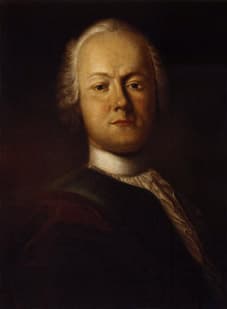
Friedrich Gottlieb Klopstock, as painted by Johann Caspar Füßli (1706-1782) in 1750.
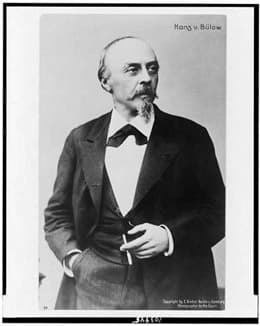
Hans von Bülow, as photographed by Leonhard Berlin-Bieber (1841-1931) between 1880 and 1894.
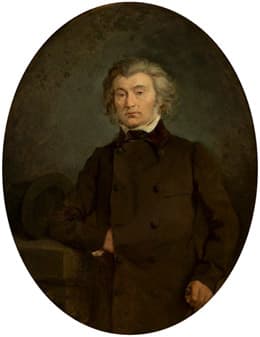
Adam Mickiewicz, as painted by Aleksander Kaminski in 1850.
Listening Guide for the First Movement
The Second Symphony begins with an ominous tremolo, out of which fragmentary scales come rumbling from the basses. These give way to halting arpeggios, over which the main melody of the first movement’s sonata form enters in the oboes and English horn. This material opens with pitches taken from the Gregorian chant “Crux fidelis” (“Faithful cross”)—using the same notes that Mahler had, in fact, quoted in the finale of his First Symphony—and it then adopts gestures from the introductory bass line. The tune’s march-like rhythms, slow speed, minor key, and dark timbre all unite to imbue the passage with the character of a funeral march. After a short yet mournful line in the woodwinds, the violins emerge with a rising melody in the major mode. Such lyricism proves ephemeral amidst a funeral march, however: both the bass scales and oboe theme briefly recur in their original minor key before the composer brings in a third idea. A major-mode harmonization of “Crux fidelis” launches this new material, and its continuation clearly derives from the rhythms of the funeral march; thus, the music easily slips back into darkness and despair for the conclusion of the exposition, as evoked by the minor key, harsh trumpet timbre, and fragments of the opening bass line. Another lyrical melody in the strings starts the development section. A series of new pastoral ideas soon follow, including a tranquil horn duet and a descending figure in the English horn that recalls the portion of Wagner’s Die Walküre (The Valkyrie) in which Odin puts Brünnhilde into a magical sleep. But sweeping figures in the strings, as well as brass fanfares, soon belie the calm. Several similar exchanges occur over the course of the development. Lyricism regularly alternates with grim proclamations of a minor-mode variant of “Crux fidelis,” and even the occasional brass fanfare resounds in a major key to hint at transcendent emotion yet to come. Yet the opening bass scales—now punctuated by crashes in the percussion and brass—reappear before the development concludes. A sighing English horn signals the return of fragments of the funeral march, in addition to a broader melody stated in the trumpet. The latter then yields the spotlight to a quartet of French horns, which anticipates the symphony’s finale by presenting both a new idea based on the Gregorian chant “Dies irae” (“Day of Wrath”)—the text of which bears a similarity to the Unetanah Tokef in that it depicts the Last Judgment—as well as a motive that Mahler will ultimately set to the word “Auferstehen” (“resurrection”). Nevertheless, the anxiety and anguish associated with the funeral march demarcate the end of the development section, as do dramatic descending scales, the reemergence of the minor-mode version of “Crux fidelis,” aggressive rhythms in the brass, and poignant dissonance. The recapitulation that ensues closely follows the lines of the exposition, at least until the lyrical second theme. Here the composer also recalls some of the pastoral ideas he initially presented in the development. Interestingly, Mahler marked this portion of the score as “Meerestille” (“calm sea”) on his original manuscript, presumably in reference to the famous poem of that title by Johann Wolfgang von Goethe (1749-1832). Although Mahler left this indication off of the published version of Symphony no. 2 (as he did a few other programmatic associations appearing on the autograph), the designation aptly describes the placid nature of this passage, even if its maritime imagery has nothing to do with either the Todtenfeier scenario, or the texts sung in the fourth and fifth movements. Because the composer omits the major-mode version of “Crux fidelis” from the recapitulation, the end of this portion of the sonata form also departs from the model of the exposition. Mahler now synthesizes the materials of his funeral march with the minor-key variation of “Crux fidelis” to make an extended, quiet close for the first movement. Only a succinct coda consisting of a descending chromatic scale in the full orchestra temporarily restores a more forceful, assertive mood before the music fades out.Listening Guide for the Second Movement
The score specifies a pause of at least five minutes after the first movement. Following this, an Andante moderato marked “Sehr gemächlich, nie eilen” (“Very leisurely, never rushing”) begins, and it creates a tremendous contrast with everything heard previously. In 1899, Mahler conveyed to Bauer-Lechner that he considered this discontinuity a fault in the symphony. Evidently Claude Debussy and Paul Dukas agreed: the second movement so displeased them during a 1910 performance that they left the concert hall, much to Mahler’s displeasure. Overall, the layout of the second movement alternates between two musical ideas. The strings open the Andante with the first of them: a “grazioso” (“graceful”) Ländler [insert link to definition of LÄNDLER at http://www.utahsymphony.org/blog/2014/09/romantics-terminology/] in the major mode. Approximately ninety seconds later, another melody appears. Its detached articulation and extremely soft volume impart a playful character, while the minor key clearly distinguishes the tune from the beginning of the movement. The woodwinds twice present a lyrical passage on top of overlapping statements of this second idea before the music rises to a peak. This, in turn, subsides into a reemergence of the Ländler. The second melody follows soon thereafter, but it extends to a greater length and reaches a larger climax—facilitated through the addition of the brass and timpani—this time around. Yet once again, it yields to the Ländler, which quietly rounds off the Andante.Listening Guide for the Third Movement
As noted in the Work History above, the third movement derives from Mahler’s setting of the Wunderhorn text “Des Antonius von Padua Fischpredigt.” This poem (given below) satirizes the legend of St. Anthony preaching to the fish in the river. The fish symbolize a congregation that listens attentively, but upon completion of the service, returns to daily life without have taken to heart the priest’s spiritual message. And Anthony too emerges as an ironical figure, since he seems perfectly content to deliver his sermon to a flock that cannot understand him.Antonius zur Predigt
Die Kirche findt ledig.
Er geht zu den Flüssen
Und predigt den Fischen!
Sie schlag’n mit den Schwänzen!
Im Sonnenschein glänzen!
Die Karpfen mit Rogen
Sind all’ hierher zogen,
Hab’n d’Mäuler aufrissen
Sich Zuhörn’s beflissen!
Kein Predigt niemalen
Den Fischen so g’fallen.
Spitzgoschete Hechte,
Die immerzu fechten,
Sind eilends herschwommen,
Zu hören den Frommen!
Auch jene Phantasten,
Die immerzu fasten:
Die Stockfisch ich meine,
Zur Predigt erscheinen.
Kein Predigt niemalen
Den Stockfisch so g’fallen.
Gut’ Aale und Hausen,
Die vornehme schmausen,
Die selbst sich bequemen,
Die Predigt vernehmen!
Auch Krebse, Schildkroten,
Sonst langsame Boten,
Steigen eilig vom Grund,
Zu hören diesen Mund!
Kein Predigt niemalen
Den Krebsen so g’fallen.
Fisch große, Fisch kleine,
Vornehm und gemeine,
Erheben die Köpfe
Wie verständ’ge Geschöpfe!
Auf Gottes Begehren
Die Predigt anhören!
Die Predigt geendet,
Ein jeder sich wendet.
Die Hechte bleiben Diebe,
Die Aale viel lieben;
Die Predigt hat g’fallen,
Sie bleiben wie Allen!
Die Krebs’ geh’n zurücke;
Die Stockfisch’ bleib’n dicke,
Die Karpfen viel fressen,
Die Predigt vergessen!
Die Predigt hat g’fallen.
Sie bleiben wie Allen!
Antonius at sermon
Finds the church empty.
He goes to the rivers
And preaches to the fishes!
They whip their tails
Glistening in the sunshine!
The carp with roe
All are drawn here
Mouths wide open,
Intent listeners!
No sermon ever
Pleased the fish so!
Sharp-mouthed pike
That fight all the time
Swam here in a hurry
To hear the piety!
Even those oddities
That fast all the time,
I mean the stockfish,
Appear at the sermon.
No sermon ever
Pleased the fish so!
Good eels and sturgeon
That elegantly feast,
They force themselves
To hear the sermon!
Also crabs, turtles,
Usually slow runners,
Rise urgently from the ground
To hear this mouth!
No sermon ever
Pleased the crabs so!
Fish large, fish small,
Noble and common,
Raise their heads
Like intelligent creatures!
At God’s wish
They listen to the sermon!
The sermon ended,
Each one turns.
The pike remain thieves,
The eels great lovers:
The sermon has pleased,
But they all remain as before.
The crabs go backwards;
The stockfish stay plump,
The carp devour many,
Forgetting the sermon!
The sermon pleased,
But they all remain as before!
Das ist ein Flöten und Geigen
Trompeten schmettern darein;
Da tanzt wohl den Hochzeitreigen
Die Herzallerliebste mein.
Das ist ein Klingen und Dröhnen,
Ein Pauken und ein Schalmei’n;
Dazwischen schluchzen und stöhnen
Die lieblichen Engelein.
There is fluting and fiddling
Trumpets blare in it
Here dances the wedding dance
My dearest.
There is a ringing and booming
A drumming and a sounding of shawms;
Between them sob and moan
The sweet angels.
Listening Guide for the Fourth Movement
Like the third movement, the fourth began as setting of a Wunderhorn poem. In this case, however, Mahler decided to use both the text and music of “Urlicht,” rather than discarding the words as he did with the “Fischpredigt.” Thus, the composer introduces the human voice—via an alto soloist—after approximately forty-five minutes of purely instrumental music. “Urlicht” expresses a longing for a spiritual union with God, whose love grants eternal life (see text below). Mahler separates the first line of text from the remainder of the poem, using it to initiate the movement. Following a choral-like passage played by a brass choir—which the composer requests sit at the rear of the orchestra—the alto sings the second, third and fourth lines of poetry. Chromaticism now infiltrates the vocal line, which gradually rises in pitch and constantly fluctuates meter. A solo oboe then closes off this first portion of the movement. A contrasting central section then begins in a minor key. As clarinet, harp, and glockenspiel mark off regular increments of time, the voice delivers the fifth, sixth, and seventh lines of text at a slightly quicker tempo. A solo violin, as well as the flute, also feature prominently in this portion of “Urlicht.” No clear pause separates the middle of the movement from the varied restatement of the opening material. Instead, Mahler sets the eighth and ninth line with a “zart drängend” (“gently urging”) figure. As the alto moves to the final line of the poem, however, the melody first heard in conjunction with the fourth line of text returns. The unexpected recurrence of this gesture produces not only the movement’s climax, but it closes the movement in a subtle and delicate manner.O Röschen rot,
Der Mensch liegt in größter Not,
Der Mensch liegt in größter Pein,
Je lieber möcht’ ich im Himmel sein.
Da kam ich auf einen breiten Weg,
Da kam ein Engelein und wollt’ mich abweisen,
Ach nein, ich ließ mich nicht abweisen.
Ich bin von Gott, ich will wieder zu Gott,
Der liebe Gott wird mir ein Lichtchen geben,
Wird leuchten mir bis in das ewig selig Leben.
O little rose red
Humanity lies in greatest need,
Humanity lies in great agony,
Ever I would prefer to be in Heaven.
Then I came upon a wide path
There came an angel who wanted to turn me away.
But no, I did not let myself be turned away.
I am from God, I want to return to God,
The loving God will give me a little light,
Which will light me into eternal, blessed life.
Listening Guide for the Fifth Movement
Many scholars interpret the fifth movement as another example of sonata form, with instrumental expositional and developmental sections, followed by a choral recapitulation. Because Mahler based the vocal portion of the finale on the same materials as its orchestral beginning, this scenario does actually describe the shape of the movement to a certain extent. However, the composer incorporates elaboration of his themes—a process normally associated with the development—in the exposition, and the act of fitting words to instrumental melodies will also necessitate substantial alteration of those materials in the recapitulatory portion of the score. After a terrifying fanfare that evokes the introduction of the choral finale to Beethoven’s Ninth Symphony, Mahler introduces the movement by means of a theme built from falling fifths, ascending scales, and descending triplets. An offstage horn call then inverts the fifths to announce the expositional portion of the form, where the “Dies irae” and “Auferstehen” materials anticipated in the first movement now figure prominently. Another gesture places pleading sighs in woodwinds above string tremolos: Mahler will set the text “O glaube” (“Oh believe”) to these passionate entreaties much later in the finale. The low brass signals the end of the exposition with varied restatements of the “Dies irae” and “Auferstehen” motives. This builds in intensity and eventually erupts in triumphant fanfares that derive from the introductory fifths and descending triplets. Beneath all this orchestral brilliance, however, trombones sound the “Auferstehen” fragment to hint at the darkness and fright that opened the movement. Drum rolls then declare the start of the developmental section, which commences with the recurrence of the terrifying and dissonant introduction. The center of the movement combines its main materials in a seemingly endless variety of ways. Mahler also transforms the characters of his themes into a number of unexpected guises. For example, the “Dies irae” becomes a serious, though initially upbeat, march—over which the composer will have the trumpets superimpose a solemn, chorale-like variation of the same melody. And in the midst of all this, the occasional quotation of “Crux fidelis” materializes, before another recollection of the introduction brings the music to a grinding halt. The development now resumes with the “O glaube” material, which grows in intensity as offstage fanfares join in. Mahler hints at a bit of lyricism before the tempo accelerates, the volume rises, and the level of dissonance increases. Horn fanfares first surface from this din—followed by the return of the falling fifths, ascending scales, and descending triplets—before the recapitulatory portion of the movement commences. In Mahler’s 1901 programmatic description of the fifth movement, a nightingale immediately precedes his image of a chorus of saints and heavenly beings singing “Auferstehen.” Thus, a flute—marked “like a bird call” (“wie eine Vogelstimne”)— accompanies the recapitulation of the first portion of the exposition. Following this and representing the aforementioned angelic host, the chorus now intones the opening stanza of Klopstock’s poem, extending the short “Auferstehen” motive into a fully-realized chorale. An orchestral interlude ensues, but the chorus interrupts in order to deliver Klopstock’s second stanza. Yet this time Mahler allows the instruments to conclude their subsequent interlude, thereby demarcating the end of Klopstock’s text and the start of his own. With the entrance of the words “O glaube” in the alto solo, the composer returns to the pleading sighs he introduced towards the end of the expositional portion of the movement. Nevertheless, a soprano quickly assumes the melody before the chorus again returns with the “Auferstehen” material, though now singing Mahler’s text and forcefully accompanied by the low brass. The alto voice emerges from the chorale to usher in a passage marked “Mit Aufschwung” (“With uplift”). The soprano soon joins, and the vocal duet briefly references the melody Mahler used to set the pivotal text of “Urlicht”: “Ich bin von Gott, ich will wieder zu Gott,” (“I am from God, I want to return to God”). Following this, the chorus presents overlapping entries of the descending-triplet material, a motive that had remained the property of the orchestra until this point in the movement. As the buildup of these gestures nears its peak, another instrumental theme—the pairing of the falling fifths and ascending scales—resounds in the chorus and horns. The organ joins for the final statement of the “Auferstehen” chorale in the chorus and brass, and bells finally chime as the brass instruments proclaim the end of the symphony.KLOPSTOCK’S TEXT
Aufersteh’n, ja aufersteh’n wirst du,
Mein Staub, nach kurzer Ruh!
Unsterblich Leben
Wird der dich rief dir geben.
Wieder aufzublüh’n wirst du gesät!
Der Herr der Ernte geht
Und sammelt Garben
Uns ein, die starben.
MAHLER’S CONTINUATION
O glaube, mein Herz, o glaube:
Es geht dir nichts verloren!
Dein ist, was du gesehnt!
Dein, was du geliebt, was du gestritten!
O glaube:
Du wardst nicht umsonst geboren!
Hast nicht umsonst gelebt, gelitten!
Was entstanen ist, das muß vergehen!
Was vergangen, auferstehen!
Hör’ auf zu beben!
Bereite dich zu leben!
O Schmerz! Du Alldurchdringer!
Dir bin ich entrungen!
O Tod! Du Allbezwinger!
Nun bist du beqwungen!
Mit Flügeln, die ich mir errungen
In heißem Liebesstreben
Wer’ ich entschweben
Zum Licht, zu dem kein Aug’ gedrungen! `
Sterben werd’ ich, um zu leben!
Aufersteh’n, ja aufersteh’n wirst du,
Mein Herz, in einem Nu!
Was du geschlagen,
Zu Gott wird es dich tragen!
Rise again, yes, you will rise again.
My dust, after a short rest!
Immortal life
He who called you will give to you.
To blossom again you are sown!
The lord of the harvest goes
And gathers, like sheaves,
We who died.
O believe, my heart, o believe:
Nothing is lost to you!
It is yours, what you desired.
It is yours, what you loved, what you struggled for.
O believe:
You were not born in vain!
You have not lived, suffered in vain!
What came into being, it must cease to be!
What passed away, it must rise again!
Stop trembling!
Prepare yourself to live!
Oh grief! You all-penetrator!
I am forced to you
O death! You all-conqueror!
Now you are defeated!
With wings that I won for myself
In fervent pursuit of love
I will waft away
To the light that no eye has penetrated
I shall die in order to live.
Rise again, yes, you will rise again,
My heart, in a moment!
What you bested
It will carry you to God!