
Mahler Online CoursePart 2 – Mahler’s Biography
by Bettie Jo Basinger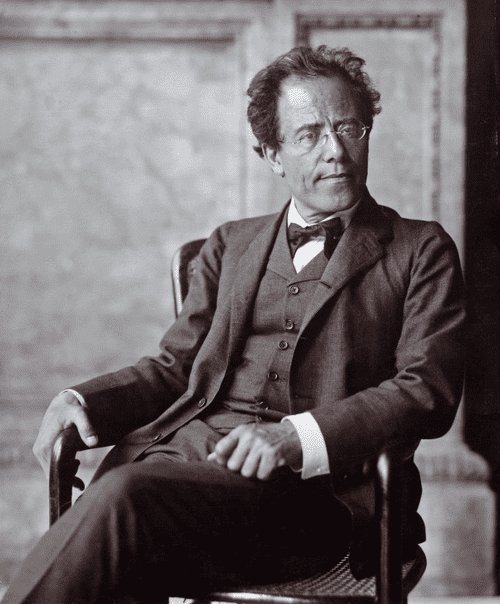
Gustav Mahler
On 7 July 1860, Gustav Mahler was born into a middle-class Jewish family living in Kalischt, a town within the Hapsburg Empire (now Kaliště in the Czech Republic). Although his parents had a total of fourteen children, Mahler became the oldest child of the six that would survive infancy. He grew up in Iglau (now Jihlava in the Czech Republich)—where his parents moved before the end of his birth year—as a German-speaking Jew within a culturally Czech community.
The primary and second schools of Iglau did not offer much in the way of musical training. Mahler nevertheless began playing the family piano at a very young age, and by the time he reached ten, many considered him a local prodigy. The music director of a nearby church—and father to one of the future composer’s boyhood friends—gave Mahler his first music lessons. In addition, the composer learned by studying the scores of past masterpieces loaned to him by libraries and teachers, as well as by absorbing the Czech and German musical traditions heard throughout the town.
At the start of the 1875-1876 academic year, Mahler entered the conservatory in Vienna, and this commenced his formal musical education. He continued to study piano at this institution, yet composition attracted more and more of his attention. His pieces earned several awards, but never the coveted Beethoven Prize which Mahler sought twice, submitting his overture for a projected opera called Die Argonauten (The Argonauts, now lost) in 1878 and the cantata Das klagende Lied (The Song of Lamentation, 1878-1880; revised 1892-1893, 1898-199) in 1881.
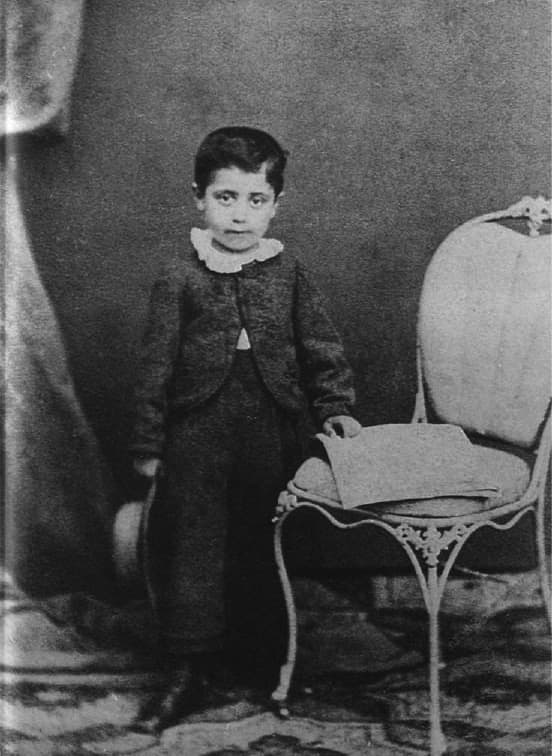
This image of Mahler probably captured him around the age of five or six. The name of the photographer remains unknown.

Emil Bieber took this photograph of Mahler around 1892. Adolph Kohut incorporated the image in his entry on the composer in the first volume of Berühmte israelitische Männer und Frauen in der Kulturgeschichte der Menschheit (Famous Jewish Men and Women in the History of Civilization) of 1900.

This cariacture of Mahler’s conducting style by Hans Schliessmann first appeared in the Germa magazine Fliegende Blätter in 1901.